Sunday, November 15, 2015
The Francis Effect: The Twerking Bishops of Indonesia
I still say that Cardinal Jaime Ortega, Archbishop of Havana, could beat them in any twerk off, though the fat bishop @ .58 would be a formidable opponent.
https://gloria.tv/media/NTpRcvdAfG7/a
H/T: Francis the Destroyer Blog

Saturday, November 14, 2015
Is a Biopic of "María Martí" in the Works at 20th Century Fox?
On November 13, 2015 at 5:35pm the José Martí Blog hosted a visit from Twentieth Century Fox (I.P. Address 216.205.224). It landed here through a search on Bing for "josé martí maría mantilla," which directed them to The Myth of José Martí's Natural Daughter.
What could this possibly mean? One thing only comes to mind: someone there is researching a screenplay based on Martí's alleged paternity of María Mantilla.
There is no evidence to support such a conjecture and much evidence to refute it (including Martí's own written denial). But, of course, Hollywood is a distorter, not a purveyor, of historical facts. Perhaps the movie studio has purchased the rights to Francisco Goldman's novel The Divine Husband, or, less likely, the truculent Romero sisters — María Mantilla's grand-daughters — have found some nonagenarian hack who knew their uncle César and was willing to put forward their suggestion for a "María Martí" biopic. Perhaps they have even prepared their own treatment (which should doom the project from the start).
We hope that whoever visited this blog on Nov. 13 from Twentieth Century Fox got a good splash of cold water and put that project forever to rest.
See also:
An E-Mail from María Mantilla's Grand-Daughters
More Observations on the Romero E-mail
Saturday, November 07, 2015
Book Review: "José Martí y la cuestión indígena" by Jorge Camacho
The greatest reverence that can be shown to any historical figure is to desire to know everything about him. The most faithful biographer is the one who provides the most complete picture of his subject, not the myth-maker or repeater of the accepted pieties who wishes us to know only what he believes will elevate our opinion of his hero. These hagiographic histories can be sincere and well-intended, and those who are satisfied by them would no doubt reject less orthodox treatments as sacrilegious or at least mischievous. So it is that the true historian, who hides nothing and puts the truth before his own interests, is often ostracized by those that hold that the truth must always be subordinate to the greater good (as they perceive it) and that to smash an idol is worse than to worship one.
No figure in Cuban history, and, indeed, few figures in world history, have been more victimized by their self-appointed "champions" than has José Martí. Indeed, it can be argued that it was not until the advent of the late Carlos Ripoll that the many coats of varnish that had been slapped on Martí's portrait were finally stripped away and the original exposed to the light much to its advantage. That work of restoration is an ongoing one, in exile, at least, if not in Cuba, where the opposite process has been underway for 56 years, resulting in a mutilated and falsified depiction of Martí which serves the purposes of the island's ruling elite, whatever those purposes happen to be at any given time: whether Martí as the "Intellectual Author of the Revolution," the somewhat slow disciple of Marx, or the nationalist cum socialist (precursor of Hitler?).
Following in the tradition of Ripoll, but now far ahead of him in the extent to which he is willing to challenge, and, indeed, decimate popular misconceptions about Martí, Jorge Camacho has authored a landmark study about José Martí y la cuestión indígena (Chapel Hill: North Carolina University Press, 2013). This until now marginal but essential subject will change forever not only our interpretation of Martí's famous essay but even Martí's relation to "Nuestra América." Camacho has demonstrated that practically everything that is standard received knowledge on this subject was not only wrong, but wrong in the worst possible way, that is, the truth was the opposite of the popular belief supported by popular scholarship. Martí was not a latter-day Bartolomé de las Casas, the "Protector of the Indians" (in truth, even las Casas is not really the canonical las Casas admired by Martí, since he saved the Indians from extinction at the price of African slavery).
Martí romanticized the indigenous peoples of the Americas and strongly castigated the Spanish for their depredations on them, especially the systematic destruction of their culture and its literary monuments. He said that the Spaniards had torn a leaf from the Book of Nature. Their descendants, however, he saw as a retrograde people that would become extinct if they did not assimilate to the dominant culture and join the concert of civilization. Assimilation was no longer a choice, but an imperative since "America will not move until the Indian moves." Getting the Indian "to move" is no easy thing and a lot harder if you are trying to make him move where he doesn't want to go. At the time that Martí was writing his crónicas for La Nación, Argentina was engaged in the systematic extermination of its indigenous population. The Argentines did not even try assimilation. As Camacho shows, Martí did not reproach his Argentine friends (all of whom were connected to the government) for their conduct, but supported their course of action both publicly and privately, even going so far as supervising the committee that translated into English for international arbitration the documents supporting Argentina's claims to the Indians' lands, which were disputed by Brazil. Martí's enthusiastic support for Indian assimilation in the United States after all the tribes had been subjugated and confined to reservations by the federal government proved in the long run almost as catastrophic as genocide: the Indians were allowed to live but "educated" out of their languages and cultures at Indian schools (such as Carlisle, which Martí praised in the highest terms). Shorn of their identity, these assimilated Indians were still racially unacceptable to whites and rejected as renegades by other Indians.
Although Martí always advocated that Latin Americans embrace their indigenous roots and not copy European models blindly and to the detriment of what was "ours," it is undeniable that he was Eurocentric to the core of his being (and what else could he be given his origins and education?). Camacho also identifies and presents credible evidence for charging Martí with cultural racism, ethnocentrism, and even racial biases. These prejudices, of course, are not the sole province of those who denigrate the Indian. His champions, too, like Martí, tend to objectify and judge him according to their own idealized conception of the noble savage and are often disappointed that the less savage the Indian becomes, the less apparent his nobility appears. And when the Indian is finally civilized — that is, no longer an Indian except in external appearances — they will mourn the loss of everything which they once desired the Indian to lose.
I am not as bold or as forthright as Jorge Camacho — not by half, which is not to say that I would have withheld the facts which he discloses; but, rather, that I would have presented them in such a way as to mitigate Martí's blame whenever possible by contrasting his attitudes to the really genocidal ones of his contemporaries (like Sarmiento's and Mitre's). In the context of his time, if not ours, Martí is among the least culpable (which is not the same as saying blameless). My approach, I suppose, shows that I am still not an impartial commentator on these matters and perhaps I never will be; but I admire Jorge Camacho for telling the truth without qualifiers or palliatives because I recognize that this is what we need. Indeed, what Martí needs and would want.
Originally published in Linden Lane Magazine, October 2015
The Devil's Advocate: Cardinal Tarcisio Bertone

"Cardinal Tarcisio Bertone, the Holy See's secretary of state under former Pope Benedict XVI, took a 23,000-euro helicopter ride to southern Italy paid for by funds for sick children from a Catholic Hospital, apparently to do 'marketing' for the hospital. The same hospital, Bambin Gesu, paid 200,000 euros for enlarging Cardinal Bertone's apartment at the Vatican, an allegation which the hospital confirmed, according to the author [Gianluigi Nuzzi] of the book [Merchants in the Temple], claiming they were also hoping to use the apartment for 'institutional' purposes." — Delia Gallagher and Daniel Burke, CNN, "New Books Allege Financial Scandals at the Vatican," November 5, 2015
The unsung "hero" of the normalization juggernaut was Cardinal Tarcisio Bertone, who did the legwork while Pope Francis took the credit. In a recent interview with the Huffington Post, Bertone admitted that he "made five trips to Cuba and made my own contribution to Cuba-U.S. relations," explaining that "it was not something that just fell from heaven; there was a lot of work behind it." Indeed, nothing of the kind "fell from heaven," though it well may have bubbled up from hell, with Bertone as its conjurer.
Bertone has always been willing to work on behalf of the Castro dynasty and its interests. Communist Cuba has no need to pay for agents of influence in the Vatican when it has Cardinal Jaime Ortega as its official lobbyist there. Bertone's special relationship with the Cuban kleptocracy is born of their mutual venality and sustained, perhaps, as it certainly is in Ortega's case, by home movies stored in the vaults of State Security.
In 2005, Cardinal Bertone called the U.S. trade embargo on Cuba "unjust and ethically unacceptable" (it would take years for the Vatican to denounce as such the clerical molestation of children); and in 2008, Bertone declared, in Havana, that "the embargo constitutes an act of oppression against the Cuban people and a violation of Cuba's independence." He did not, however, condemn the oppression of the Cuban people by the Castro regime, nor explain why the refusal of the U.S. to trade with Communist Cuba oppresses its people or violates its independence while the denial of human and civil rights to its citizenry by its unelected rulers does not.
Moreover, how can a country be "independent" which blames all its domestic troubles on its inability to trade with another country (and "trade" as defined by Castro always means being subsidized by a third country in exchange for surrendering Cuba's independence to it)? The most notorious example in modern times of a servile state is surely Communist Cuba's 30-year vassalage to the Soviet Union which ended only when the Soviet empire itself ended. Yet never did the Vatican protest the fact that Cuba's main export to the Soviet Union was cannon fodder. One would suppose that such trade would be more objectionable to the Vatican than the absence of such trade. But such contradictions are the stock in trade of Vatican diplomacy, which supported sanctions on South Africa's apartheid regime but not on Cuba's apartheid regime.
Of course, Cardinal Bertone, as an exploiter and despoiler himself, sees nothing wrong with using humans as chattel or profiting from their misery. It is no surprise that a man who hails Fidel Castro as a "humanitarian" would believe that he, too, can commit any vile act and still be considered a "humanitarian," The fact that his carrion prey are children and sick children at that explains the great affinity between Castro and Bertone, for Castro has never had any mental reservations about stealing the kids milk money, much less their future.
Wednesday, October 21, 2015
Italian Newspaper Reports that Pope Francis Has a Brain Tumor
The Italian newspaper Quotidiano Nazionale reports that Pope Francis has a brain tumor, which was diagnosed recently.
Well, that would explain a lot of things.
The Vatican promptly dismissed the report, characterizing it as "gravely irresponsible and unworthy of attention," which does not mean untrue. The only rebuttal it could offer was to point out that "the Pope is carrying out his very intense activity in a totally normal way."
The denial may be the confirmation.
In ancient times (and perhaps even today since everything that happens in a conclave must be kept secret under threat of excommunication), a pope had to submit to a digital examination of his testicles before his election was declared valid because eunuchs were excluded from the clergy. [Deut 23: "He that is wounded in the stones, or hath his privy member cut off, shall not enter into the congregation of the LORD."] This ceremony also insured that no female (or no female after "Pope Joan") would ever be elected pope (again).
Since it is obviously more important that a pope should have a fully working brain than the right reproductive organs in good order, perhaps all future candidates should be required to undergo a brain scan before assuming office.
Sunday, October 18, 2015
Francis: The Totalitarian Pope
It hadn't occurred to me before, but now I believe that I have discerned the real reason for Pope Francis' trip to Cuba. He went there, like every left-wing Latin American politico, to consult with Fidel Castro about how best to consolidate his power and eliminate all vestiges of democratic discourse within the Church. Or, to put it simply, Francis wanted to learn how to be like Fidel, and how better than at the feet of the master?
Here's the proof:
Pope Francis is now effectively at war with the Vatican. If he wins, the Catholic Church could fall apart
Wednesday, October 14, 2015
Pope Francis Is Sorry, But Not for Forsaking Cubans
Pope Francis has issued a public apology for everything and anything that he has done wrong during his disastrous two-year pontificate. He has not shown contrition, however, for his fawning embrace of the Castro brothers, his refusal to meet with Cuba's political prisoners and human rights activists, or his role in initiating a dialogue between Barack Obama and Raúl Castro which led to the "normalization" of diplomatic relations between the U.S. and Communist Cuba as well as the pogrom unleashed in its wake against Cuba's dissidents, which the pope witnessed himself with absolute indifference and subsequent denial during his recent trip to the island. Francis' ultimate goal and greatest sin in the offing — the lifting of the trade embargo — will insure the survival of the Castro dynasty in perpetuity with the U.S. as its co-signer and accomplice. In reconciling good and evil, Francis has done more than Christ himself wanted or presumed to do. So much for his vaunted "humility," not to mention his doctrinal purity.
Barack Obama is infamous for apologizing in the name of the U.S. for "historical wrongs" which other presidents allegedly committed, which is just another way of cutting them down a few pegs and bringing them closer to his level. The last three popes, and John Paul II in particular, have also skewered their predecessors for not being 21st century men in the 16th century. Francis stands alone, however, in his eagerness to prove his "humility" by acknowledging just what a mess he has made of everything, except as a pimp for the world's oldest dictatorship.
Sunday, October 04, 2015
Pope Francis Greets Yayo and Iwan (But No Cubans Besides the Castros)
Before meeting with Kim Davis, the four times married and three times divorced champion of traditional marriage, the pope granted a private audience — a "real audience" as the papal spokesman called it — to former student Obdulio "Yayo" Grassi and his Indonesian boyfriend Iwan Bagus, who have been together for 19 years, since Mr. Grassi, now 67, was 48; and Mr. Bagus, now 33, was ... you do the math. The media, of course, did not do the math. This was not just a same-sex couple but something which most people would find far more sinister and which the pope himself condemned at another venue in the harshest words he used during his trip to the U.S.
What could be more Borgian, and, at the same time, worthier of this pope, who blesses with the left hand what he condemns with the right, than to embrace in the span of 24 hours a gay couple and the scourge of gay couples? And what better defines American liberals than taking umbrage at the pope for following traditional Catholic teaching and praising him when he acts like a Unitarian Universalist? It's not a battle for the souls of the faithful anymore. The battle now is for the mind and heart of the pope. The pope appears to know this and consciously aspires to be all things to all men and nothing in particular.
In Cuba, Pope Francis gave no indication of divided loyalties. He stood with Fidel and Raúl Castro and with nobody else.
Thursday, October 01, 2015
Pope Francis Gave Private Audiences to All and Sundry, Except Cuban Dissidents
"I spent a little time Wednesday night examining my conscience, as we used to say around the ol' confessional, as regards the meeting between Papa Francesco and noted civic layabout Kim Davis. This contemplation was prompted by two things: first, an e-conversation I had with someone who had been part of the papal travelling party and second, the appearance of E. J. Dionne on Lawrence O'Donnell's show on MSNBC. According to the first person, there were a great number of people during the pope's tour who were simply hustled in and out for informal private audiences. According to Dionne, the meeting between Davis and the pope was brokered by Archbishop Carlo Vigano, the papal nuncio to the United States at whose residence the pope stayed during his time in Washington, which is when the meeting took place. Together, these facts set off my Spidey Sense about Vatican chicanery.
"Before we continue, let us stipulate a few things. First of all, let us stipulate that there are more than a few members of the Church's permanent bureaucracy, both within the Clan Of The Red Beanie and without, who are not happy that this gentleman got elected Pope, and who are not happy with what he's done and said since he was. Second, let us stipulate that many members of this group are loyal to both former pope Josef Ratzinger and, through him, to the memory (and to what they perceive as the legacy) of John Paul II who, for good and ill, had a much different idea of how to wield a papacy than Papa Francesco does. Third, let us stipulate that this opposition to the current pope has been active and vocal, to say nothing of paranoid. Finally, let us stipulate that, for over 2000 years, the Vatican has been a hotbed of intrigue, betrayal, and sanctified ratfcking on a very high scale. (It also has been a hotbed of, well, hot beds, but that's neither here nor there at the moment.)" —Charles P. Pierce, "Was the Pope Actually Swindled into Meeting Kim Davis?" on Esquire.com, October 1, 2015
Try to swallow the spoiled style, reeking with various bacteria, and consider what Mr. Pierce is actually saying. No, not that Pope Francis is an addle-brained imbecile at the mercy of Ratzinger's minions (not that we are disputing that premise). For our purposes it is far more interesting that there was allegedly a revolving door at the papal nuncio's Washington residence through which "a great number of people ... were simply hustled in and out for informal private audiences" with the pope: Kim Davis, the thrice-divorced champion of the sanctity of marriage, being just one in a long line of lay supplicants to meet with the pope and receive his blessing.
In Cuba, the only "lay supplicant" with whom the pope deigned to meet was Fidel Castro. The pope specifically excluded Cuban political prisoners and human rights activists from his sight and presence, and even admitted as much to reporters on the flight from Santiago de Cuba to Washington:
"[F]irst, it was very clear that I was not going to give audiences because not only the dissidents asked for audiences, but also audiences [were requested] from other sectors, including from the chief of state. And, no, I am on a visit to a nation, and just that. I know that I hadn’t planned any audience with the dissidents or the others."
His trip, Francis said, was not political and neither was he himself political. In Cuba, at least. In his address to a joint session of Congress, the mask came off: the pope confessed himself to be a political animal since his boyhood days at his grandmother's knee. And he proved that he still was when he politicized his every action in this country, seeking to impress the left while not completely alienating the right — a challenge for the most deft of politicians let alone for the most daft of popes (My God, Pierce's style is contagious!).
POSTSCRIPT:
The Vatican acknowledged today that “Pope Francis met with several dozen persons who had been invited by the Nunciature to greet him as he prepared to leave Washington for New York City. Such brief greetings occur on all papal visits and are due to the pope’s characteristic kindness and availability. The only real audience granted by the pope at the Nunciature was with one of his former students and his family.”
What distinguishes a "real audience" from an unreal audience?
In any case, no Cuban was granted a "real audience" or even an "unreal audience" with the pope except Fidel Castro, and in his case the pope not only solicited the audience but actually went to Castro's home to meet him.
As for "the pope’s characteristic kindness and availability," it was conspicuous by its absence when it came to meeting with Cubans whose last name was not Castro.
In His Own Words: John Paul II Praises "Ché" Guevara and the Cuban Revolution's "Achievements"
"I am not completely up-to-date on the problems facing Cuba [when asked by an Italian reporter to assess the last 40 years (1958-1998) of Cuban history]. I am still studying, but according to the news and what the [Cuban] bishops have told me, there has been progress. For example, in the extension of education and in the area of health care. I am sure that this is in fact so, because Marx's followers did the same everywhere, including the Soviet bloc. From that perspective there has been progress in the means of delivering those services; but as refers to the human being, his rights as an individual, there has probably been less progress. That is where progress remains to be made. We live caught between two opposed ideologies: the Communist or Marxist and the liberal or individualistic. We must search for and find a just solution [i.e. third way]" — John Paul II, accepting the pernicious myth of social progress under Communism while rejecting individualism as the only means to obtain both freedom and social justice, quoted in Ibid.
“I want to express the interest with which I observe the determination of the Cuban authorities to maintain and develop the achievements made in the fields of health care, education at its various levels, and culture in its different expressions. The Holy See believes that by guaranteeing these conditions of human existence [you] erect some of the pillars of the building of peace, which is not only the absence of war but also the ability to enjoy an integral human promotion of the health and harmonic growth of the body and spirit of all the members of a society.”
“For its part, Cuba distinguishes itself for its spirit of solidarity, made evident by the shipment of personnel and material resources to satisfy the basic necessities of several populations in cases of natural calamities, conflicts or poverty. The Church's Social Doctrine has developed much in recent years, precisely to illuminate the situations that require that dimension of solidarity in the pursuit of justice and truth.” — John Paul II, praising Cuban "internationalism" and the fraudulent "achievements" of the Castro dictatorship as "pillars of peace," at the presentation of the credentials of Raúl Roa Kouri as the regime's ambassador to the Vatican, January 8, 2005
Pope John Paul II and "Ché" Guevara Honored in One Monument
Notable and Still Unforgettable: Pope John Paul II Praises "Ché" Guevara
Wednesday, September 30, 2015
Pope Francis Bets All His Moral Capital on a Long Shot: Gay Marriage
Gay Marriage?
Really?
This is what Pope Francis was willing to squander all his hoarded moral capital on?
Gay marriage?
A moot question now, at least in this country (and in the pope's native Argentina as well).
The Vatican admitted today that the pope had granted a private audience to Kim Davis, the Rowan County (KY) clerk who is leading (and losing) Custer's last stand against gay marriage.
The pope may have acted from principle, and because a cause is lost does not necessarily make it a bad cause. But should gay marriage take precedence over every other cause?
Francis was willing to overlook the suffering of the Cuban people when he refused to meet with its authentic representatives — those who put their lives on the line every day to secure the freedom and human rights of all Cubans — preferring instead to visit and praise the man who enslaved them.
Should not the blood of Cubans be more of a priority to the pope than the issuance of same-sex marriage licenses?
Is it more important to the pope to make a symbolic gesture against gay marriage than a real attempt to save lives?
Yes, it would have been quixotic for Francis to agree to meet with Cuba's beleaguered dissidents.
But no more quixotic than his secret meeting with the last U.S. official (a county clerk) to offer active resistance to the Supreme Court decision legalizing gay marriage.
The pope obviously thought that the cause of humanity demanded that he draw the line at gay marriage.
Too bad that the plight of the Cuban people did not meet that high threshold of humanity.
John Paul II and Fidel Castro: Three Different Ways to Clasp Hands
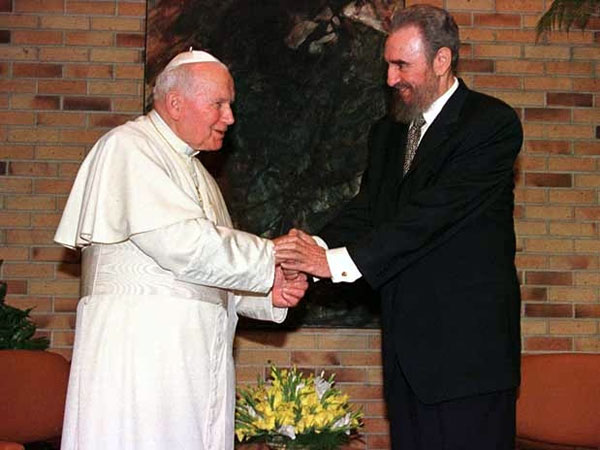


There have been a few articles published recently contrasting John Paul II's visit to Cuba in 1998 with Pope Francis'. All have given the advantage to John Paul, and, indeed, used the first papal visit to lambaste the latest. Although we are glad to have Francis' pilgrimage to meet Fidel Castro disparaged, it does not seem quite fair to blame the Argentine pope for following in the footsteps of his Polish predecessor; nor can we see anything that distinguishes the conduct of one from the other.
The phrase everybody remembers from John Paul's trip to Cuba was his call for the island to open itself to the world, and the world to open itself to Cuba. So innocuous was it that even Pope Francis felt that he could repeat it without giving offence to his hosts.
For Cubans, the problem with Cuba then as now is not that it is closed to the world, but that it is closed to them. Whether or no they are actually in a prison, Cubans are, for all intents and purposes, under house arrest, since they cannot leave their homes and settle elsewhere, whether in Cuba itself or abroad. Cubans are forbidden to move from province to province; from city to city; and even from one house to another house on the same block without the prior authorization of the state. Cuban citizens require both an exit visa to leave their country and an entry visa to return; and rarely are those who leave allowed to return (not that any but Castro's spies would want to). The only blockade facing Cubans is an internal one: they are hostages of a police state which has enslaved and interned them in a massive island-prison whose walls are as high as the sky and as deep as the ocean.
It was to Fidel Castro personally that John Paul should have addressed his request to open that prison and free its captives, as Reagan did when he challenged Gorbachev by name to "tear down that wall." Nothing that the outside world could have done — certainly not paying ransom to the captors — would have demolished the Berlin Wall, as John Paul well knew. He should also have known (and was too smart not to have known) that unilateral concessions to Castro would not obtain freedom for the Cuban people. "Opening the world (i.e. the U.S.)" to the tyrant would only strengthen him and make his victims even more vulnerable. Yet that was John Paul's solution to the "Cuban Problem" and his "solution" has been carried out by Francis to the detriment of all Cubans except Castro and his henchmen.
While in Cuba, John Paul engaged in a virtual orgy of hand-clasping with Fidel; but, like Benedict XVI and Pope Francis, refused to meet with or even allude to Cuba's political prisoners or human rights activists. John Paul, on his flight to Cuba, even praised "Ché" Guevara as someone whom he "was sure had desired to do good for the poor." Francis said nothing about "Ché" Guevara, although, like all Argentinians (whether on the left or right), the pope feels proud of that connection (as we may infer from Cardinal Sean O'Malley's comment about his "great joy and pride" in celebrating mass "under the picture of his fellow Argentine Che Guevara").
Pope John Paul II did not publicly lecture Fidel Castro on human rights or condemn his regime's violations of those rights as he had done in front of Ferdinand Marcos during his trip to the Philippines ["It is a fundamental principle, upheld always by the Church, that a government exists only for the service of man and for the protection of his dignity and cannot claim to serve the common good when human rights are not safeguarded."] Being a persecutor of the Catholic Church guarantees left-wing dictators respect and deference from the Holy Father. If Marcos had confiscated all Church property in his country as Castro did in Cuba and then had it in his power to return that property, he would not have been excoriated by the pope either.
On that first papal visit, the Cuban people genuinely believed that the pope was on their side. It seemed inconceivable then that the man who had defeated Communism in his native Poland and the Soviet bloc would uphold it in their country. The crowd at his first public mass waited anxiously for any indication of support or even one word of commiseration. What they got was John Paul's personal assurance to Fidel Castro that "the values of the Gospel of Jesus Christ are not a threat to any social project," and that what he had come to Cuba to promote was "the Gospel of Christ, not a political ideology or economic system." The pope's chief concern, then, was to guarantee the regime that the Church in Cuba, unlike the Church in Poland, would never become with his sanction an arsenal of ideas or a bulwark of liberty.
As if to encourage John Paul to remember their suffering and its cause, the crowd that heard his words but could not believe that he had abandoned them, began to chant "¡Libertad, Libertad!" The pope at first ignored their cries, and then, when they would not stop, John Paul admonished them to seek freedom in Christ.
Their lives on earth, apparently, were intended to be a never-ending hell; and the only hope that the pope held out to them was in the afterlife. As for this life, this island and this people, the pope graciously ceded all to the Cuban despot. Such papal conduct finds many parallels in the Dark Ages, but this is the first instance of such a dynastic concession in our own. It need hardly be pointed out that Pope John Paul was not willing to surrender the Polish nation to Communist slavery in perpetuity. Cubans, however, were quite expendable and apparently worthless in the eyes of the vicar of Christ. His successors have followed his example.
In Havana, Pope Francis is no John Paul II (In Havana, Pope John Paul II was no John Paul II, either).
Tuesday, September 29, 2015
Guest Post: Francis Pays Homage to Fidel Castro

Pope Francis met Fidel Castro on September 20, 2015, during his visit to Havana. As you can see in the photo above, the Pope showed a warm admiration for the decrepit tyrant of Cuba. One could say Francis seems to be venerating the communist despot as he bows to Castro and strongly presses his bloody hands.
Expressions of papal admiration can also be seen in [other photographs] , in which Bergoglio seems deeply touched and even emotional to be with Fidel.
[These attest to] the climate of mutual cordiality between the representative of Catholics and the criminal responsible for more than 50 years of brutally murdering Catholics opposed to Communism.
According to the video distributed by the Cuban government, "Pope Francis thanked Fidel and Cuba for their contribution [to] peace in a world filled with hatred and aggression." If this statement is objective, it reveals the hypocrisy of Jorge Bergoglio, because it is public knowledge that Fidel and Cuba exported armed revolution and guerilla warfare throughout Latin America and Africa as much as they could during almost the whole time Fidel Castro was in charge.
Francis offered Castro his latest Encyclical Laudato si, and the criminal offered the Pope a book — Fidel and Religion — written by Frei Betto, a Brazilian ex-guerrilla monk, today a leader of Liberation Theology.
A final detail, in 2012 Benedict XVI also met Fidel Castro on his visit to Cuba, but the tyrant went to meet him at the Papal Nunciature in Havana; on this occasion Francis went to the place Castro chose and at his convenience. Another symbol of the papal subservience to Communism.
A video of the encounter in Spanish distributed by the communist newspaper Granma can be viewed here.
By Fr. Atila Sinke Guimarães
From Tradition in Action
Sunday, September 27, 2015
The Real Dorothy Day: A Castro Groupie

"In these times when social concerns are so important, I cannot fail to mention the Servant of God Dorothy Day, who founded the Catholic Worker Movement. Her social activism, her passion for justice and for the cause of the oppressed, were inspired by the Gospel, her faith, and the example of the saints... Dorothy Day [championed] social justice and the rights of persons. A nation can be considered great when it [...] strives for justice and the cause of the oppressed, as Dorothy Day did by her tireless work." — Pope Francis, addressing a joint session of Congress, on September 26, 2015
Know whom the pope admires and you will know who and what he is.
"I am most of all interested in the religious life of the [Cuban] people and so must not be on the side of a regime that favors the extirpation of religion. On the other hand, when that regime is bending all its efforts to make a good life for the people, a naturally good life (on which grace can build) one cannot help but be in favor of the measures taken.
"We are on the side of the [Cuban] revolution. We believe there must be new concepts of property, which is proper to man, and that the new concept is not so new. There is a Christian communism and a Christian capitalism. We believe in farming communes and cooperatives and will be happy to see how they work out in Cuba. God bless Castro and all those who are seeing Christ in the poor. God bless all those who are seeking the brotherhood of man because in loving their brothers they love God even though they deny Him." — Dorothy Day, writing in the Catholic Worker, July-August 1962.
This is what Dorothy Day, co-founder of the Catholic Worker Movement,"tireless striver[er] for social justice and the cause of the oppressed," who was supposedly "inspired by the Gospel, her faith, and the example of the saints," wrote after John XXIII had excommunicated Fidel Castro for expelling most of Cuba's priests and nuns from the island; closing all parochial schools and the Catholic University (and invalidating their degrees); confiscating Catholic hospitals and orphanages; newspapers, radio stations and publishing house; looting and desecrating churches; and forcing the Cardinal-Archbishop of Havana to take refuge in a foreign embassy, in effect. decapitating the Cuban Church. Castro by then had also deprived Cuban workers (Catholic or not) of all protections under the law. His regime abolished in 1959 the right to organize unions; it outlawed strikes; it repealed minimum wage laws; it discarded collective bargaining and arbitration; it eliminated tenure and seniority; it scrapped Cuba's 35-hour work week (for which workers were entitled to 40 hours' pay); it rescinded the "13th month" bonus paid to all workers at Christmas; it authorized the payment of wages in script; and it instituted compulsory unpaid work for the State. Everything, in short, that you would expect Dorothy Day to denounce if these outrages had occurred in her own country to her beloved Catholic workers. But when Castro's Revolution did all these things to Cuba's Catholics and workers, she "could not help but be in favor of the measures taken."
Want to really get angry?
Savor this quotation from the same article, for sheer ignorance and condescension unequaled until Pope Francis' own recent statements in Cuba:
"So here we have the problem. The education of the people. Fifty percent of Cuba’s millions were illiterate. No wonder Castro had to talk for so many hours at a time, giving background and painting a picture of what they were aiming at, for a multitude who could not read."
In "Dorothy Day, a Communist?", David H. Lukenbill writes:
"I’ve been studying this issue for some time and have reached the conclusion that Dorothy Day had so conflated Communism and Catholicism in her own mind that she saw them as one and the same; which is the only explanation I can find for her lifetime support of Communist governments and ideology, co-existing with devout practice of her Catholic faith.
"Another clear mark, in my opinion, of her lifetime adherence to Communism was that she never denounced it or its evils to protect others from becoming ensnared, which is what most people, yours truly included, do once they see a past way of life clearly for the wrong path it was."
Pope Francis Embraces the Guilty and Shuns the Innocent
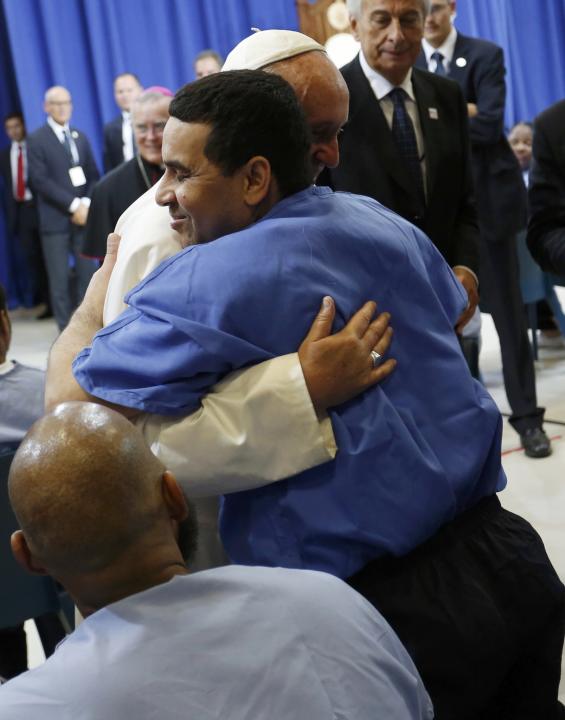
Last week there were more abortions in the United States (16,799) than there have been executions over the last 400 years (15,269). There were 35 criminals put to death in the U.S. last year as compared to more than a million babies who had the death penalty imposed on them without the benefit of judge, jury or appeal. Yet Pope Francis, in his pandering address to a joint session of Congress, barely alluded to abortion and did not condemn it, but spoke at length and vehemently against the death penalty. This is what it means to have a pope who is a moral relativist, someone who, simply put, cannot distinguish between good and evil. Such myopism would be disastrous for any man and more disastrous for those who have anything to do with him. But for a pope, it is a calamity for all mankind.
Now the pope has just met and embraced prison inmates in Philadelphia, murderers, rapists and other criminals, most, no doubt, moral relativists like himself, offering to all support and encouragement as if each were St. Dismas (The Good Thief). Francis has said that "Jesus was a failure in life," and so when he looks at the faces of these prisoners, he must see the image of Christ. Aborted babies are not pretty to look at, but their humanity shines all the more because of the barbarity to which they have been subjected.
When Francis visited Cuba just a week ago, he met and embraced much more notorious and prolific murderers. Unlike the prisoners in Philadelphia, they have never been called to account for their crimes and it is likely that they never will be. History will not absolve Fidel or Raúl Castro, but Pope Francis has. When a priest visits the home of an unrepentant public sinner and does not ask him to repent, but showers him with praise and gifts — indeed, indulgences — the sin is not expunged but it is rewarded and public morals and religion are defiled. This itself is a mortal sin, for in condoning Castro's crimes Francis has acquired a share in them.
The pope did not visit the 3000 common criminals that Raúl Castro amnestied in his honor. He could well have preened himself on that "victory" but for the fact that his refusal to meet with Cuba's dissidents and political prisoners would have seemed even more inexplicable and inexcusable if the pope had embraced the guilty and shunned the innocent, and since he would not embrace the innocent he found it expedient to shun them both. For Francis, the opponents of a one-party state are simply rival politicians even if politics as such does not exist in their country. He does not recognize them as victims of the regime but as pariahs, and even worse than pariahs because they threaten the special relationship between Church and State which the pope is so anxious to maintain and expand at any cost.
Pope Francis cannot make Cuban dissidents disappear, But he can do the next best thing — ignore and marginalize them. And he has.
Francis Stumbles Boarding Plane to Philadelphia
It is painful to watch this video of a corpulent near-octogenarian stumbling continually over his long frock as he struggles to mount the airplane stairs, more crawling than walking erect, a strong wind blinding him with his own mozzetta (short cape-like hood) and almost pushing him backwards while he holds on to the banister with one hand and his briefcase with the other: a picture of helplessness and vulnerability. Surely they can install a stair climber for him or lift him up in a crane. Perhaps he is too proud to show how really incapacitated he is. His assistants withheld their assistance in order not to embarrass him. Their concern for his feelings may well have cost him his life. I suppose that losing some weight, raising the hem of his frock a few inches and letting some young priest carry his briefcase might also help.
One last suggestion: as a sign of humility, Francis discarded the red shoes and socks traditionally worn by popes. He should reconsider that decision. The red shoes would allow him to see his own feet and prevent him from tripping over them.
Even if Francis does not have an ounce of compassion for the Cuban people, he does not deserve to be a "martyr" of any kind.
Saturday, September 26, 2015
Is Pope Francis the "Anti-Christ?"

I invite my readers to visit the Pope Francis the Destroyer Blog. Not even the Vatican's own websites chronicle the day to day activities of the pope as minutely as does this blog. In 2014, the 365 days of the year yielded 588 posts, and in what has transpired of 2015, 630. Granted, this blog is somewhat tendentious in its depiction of Francis as the Anti-Christ but not more so than the thousand blogs which just as tendentiously portray him as the Vicar of Christ. The truth does not lie in the middle. He can be one or the other; you can't split the difference. I will spend this week-end reading this blog and forming my own conclusion. After this past week I have a completely open mind about the pope (which means that I don't reject the worst said about him reflexively nor accept the best on faith). I am not endorsing the idea that Francis is the Anti-Christ or that there is even an Anti-Christ. I do believe that in many respects Francis speaks and acts as the Anti-Christ would if there were an Anti-Christ. But whom am I to judge? (to quote Francis' signature meme).
Friday, September 25, 2015

Guest Post: Pope Francis to Become "Pope Hippocritus"
The Vatican (which is a sovereign state with immigration laws) that already built [its] Great Wall of Trump centuries ago, just announced that [it] will take in the millions of mostly Muslim refugees seeking sanctuary. And that [it] will sell the Vatican's vast treasures of art, gold, and jewels to feed them. Yea right?
That was followed by a Papal decree informing the world that the Pope's new name has obviously been changed to Pope Hippocritus!
Thursday, September 24, 2015
Francis: A Pope with No Moral Compass
"Is this not what we want for our own children? We must not be taken aback by their numbers, but rather view them as persons, seeing their faces and listening to their stories, trying to respond as best we can to their situation. To respond in a way which is always humane, just and fraternal." — Pope Francis in an address to a joint session of Congress, September 24, 2015
What utter unmitigated gall! This is a pope who denies the right of Cuban citizens to live with dignity in their own country while upholding the prerogative of illegal immigrants to decamp in a foreign country, break its laws and disrupt its social order because Americans have a supposed moral obligation to treat the interlopers as they would want their own children to be treated.
But did Francis treat Cubans as his own children on his recent sojourn to the island: would a father allow his children to be beaten and dragged away in his sight and not attempt to shield or comfort them, or at least inquire about their fate and whereabouts? In refusing to be seen with dissidents on his trip to meet Fidel Castro, Francis showed that he does not "view [Cubans] as persons" worthy of his attention or consideration (unless their surname is "Castro") and feels no need to "see their faces or listen to their stories," much less "respond as best [he] could to their situation" in "a way that is always humane, just and fraternal."
No man is more worthy of contempt than one whose own words condemn him.

Subscribe to:
Posts (Atom)
