Sunday, March 29, 2015
"Fidel Castro Sent to Siberia"
According to the Siberian Times, it's a typical news day in Siberia. Former Ukraine president's son Viktor Yanukovych's "mysteriously" drowned when his vehicle fell through the ice on Lake Baikal which "he should have known was too dangerous to drive on." There's a story about a father who threw his infant son out the window of his apartment while under the influence of a new synthetic drug which caused the man to hallucinate that his home was filled with gas (a passerby broke the child's fall and he survived). And Shilka, the first polar bear born in Siberia in 40 years, is headed for a zoo in Osaka, Japan because the local zoo in Navosibirsk didn't have the 110 million rubles ($1.6 million dollars) to construct a suitable habitat for her (would't Lake Baikal have been suitable enough or is it too filled with humans?).
None of these stories, however, was the leader in today's Siberian Times. The top story was: "Fidel Castro Sent to Siberia." Oh, consummation devoutly to be wished! In permafrost, I thought for a moment, waiting to be resurrected with other mastodons? No, alas, it is his son, namesake and spitting image, Cuba's premier niño bitongo, now 66 years old. (Coincidentally, that is also Prince Charles' age. Well, at least Charles is still the heir apparent; Fidelito is not even the heir presumptive).
Fidel Castro Díaz-Balart, scientific adviser to the Council of State and former head of Cuba's (failed) nuclear program, was supposedly sent to Siberia to strengthen "economic and academic" ties between Cuba and Siberia. The story noted Fidel père's special interest in this project.
The story did not, however, mention Cuba's historical ties to Siberia, which actually do exist thanks to that amazing artificer of ties between unrelated countries which nonetheless share totalitarian affinities, the real basis of all "solidarity" and "internationalism" in the Communist underworld. During the 1980s, Cuba sent 30,000 Cuban lumberjacks to Siberia to replace the aging denizens of the Gulag and complete the great work of deforestation begun by Stalin and replicated by Castro in Cuba. That, at least, was the official version of the story. How apt Cubans were for such work in subzero temperatures has yet to be explained, or whether Cuba's prevailing interest in this fraternal enterprise was disposing of yews or disposing of "Jews" (i.e. Cubans).
"Fidel Castro Sent to Siberia" from Siberian Times

Sunday, March 08, 2015
"José Martí: A Revolutionary Life" by Alfred J. López
Let not this be mistaken as my review of Alfred J. López's José Martí: A Revolutionary Life (University of Texas Press, 2014). This work which became, immediately upon publication, the first and only professional biography of Martí, deserves better of me than this cursory note. To have reached that preeminence before López's biography required little more than to include an index, footnotes and bibliography. All these are missing without exception from previous attempts in Spanish and understandably so, since most of Martí's so-called biographies are prose poems that chronicle the author's particular devotion to him and do not require that fact to be documented. In English, there have been biographies which contained the requisite academic apparatus but whose text made it abundantly clear that these resources, if consulted at all, had been misunderstood or subordinated to a grand plan to distort Martí's life and thought and drive him into a political rut which he had always consciously avoided. López's effort is notable, and, indeed, singular, because it is neither hagiographic nor tendentious; it gathers the facts, from the widest range of sources, and presents them objectively and in concert. No aspect of Martí's life is slighted in favor of another. No subject is avoided because it does not rise to the gravitas which is usually imposed on Martí. The facts are enough to give Martí his proper stature and they do. It is not López's driving concern to instill in you love and admiration for Martí; but love and admiration you will feel, after reading this book, even if you had never heard of Martí before.
It is remarkable that no friend or close acquaintance of Martí's — not even Gonzalo de Quesada, who was nearest to being his Boswell — ever attempted to write his biography. We owe to his disciples only reminiscences of Martí short on facts and long on praise, which assure us of the reverence which he inspired in life but do not bring us closer to the man himself. This is indeed most unfortunate but perhaps inevitable: those who viewed him at the closest proximity were most aware of how truly daunting was the task of capturing for posterity the full extent of his genius and his humanity. To have attempted and failed to do him justice was simply a risk that none of them wished to take out of regard for him and fear of damaging their own reputations.
It is also to be lamented — and López laments it, too — that Carlos Ripoll, who wrote more than 20 books on Martí and hundreds of articles and pamphlets on every imaginable aspect of his life, never attempted a comprehensive one-volume biography. It was not from want of encouragement. All his friends, including me, suggested it to him. Indeed, I tried to convince him that he had already written such a biography and published it serially, if not sequentially, over 40 years. All he had to do was to put all his articles in chronological order, eliminate any repetitions and create transitions when necessary, and the biography would be a fait accompli. Of course, such a task of condensation would have baffled if not defeated even the editors of Reader's Digest. But time was precious to him and he wanted to use what little remained to continue exploring other facets of Martí's life and searching for the new and unknown, which was his life's passion. Ripoll was always too occupied making new discoveries about Martí — that is, changing and augmenting the facts of his biography — to actually write his biography, or, rather, to take a cache image of something that was always in flux thanks to him. But now that his pen is stilled, it is possible, indeed essential, for someone to synthesize his discoveries and give us a biography of Martí that incorporates them, which, by virtue of that fact, will be the definitive biography.
I will not say that this is the biography that Ripoll would have written if he had had the time and inclination. I will say, however, that it is the closest approach that we will ever have to a one-volume biography by Ripoll. Moreover, López's admiration for Ripoll is the surest guarantee of his intellectual honesty and his impeccable lineage as a martiano. We quote from the Acknowledgments page of his book: "Astute readers will note one particular name that figures prominently in this book's bibliography. Carlos Ripoll (1922-2011) was the preeminent Martí scholar of his time, a tirelessly prolific researcher whose work on Martí remains unmatched for quality and range of vision. Although I have not always agreed with Ripoll's conclusions regarding certain aspects of Martí's life, I owe him a great debt for the substantial contribution his lifetime of work has made to this book."
No one who knows how vilified Carlos Ripoll was and still is among the official falsifiers of Martí's legacy in Cuba could imagine that praising him in such terms would ingratiate López to Ripoll's enemies and allow him free access to Cuban archives, which cannot be consulted without prior authorization from the Council of State. In fact, López, who was born in the United States, has never set foot in Cuba. And it is just as well, because the regime has decimated those archives, selling their choicest items to collectors abroad and not even bothering to preserve Xerox copies which would be proof of their sordid business. Ashes and sackcloth is all that awaits future historians in Cuba. To write about Cuba's past they will have to search the world for documentary evidence because nothing of value will remain in Cuba (fortunately, much of our history is in foreign archives).
Castro, quite literally, has robbed us of our present and our past; and those who have reconstructed that past, like Ripoll and López, have performed a service for our country. Of course, there have also been opportunists, like Louis Pérez and Laura Lomas, who, without compunction of any kind, have placed themselves at the service of the Castro regime and been rewarded for their obeisance (Pérez with a medal and Lomas by having her error-filled book mercifully ignored in Cuba). López should not be classed with them. Certainly his detractors should not announce before judging him that they have not and will not read his book, nor should they condemn him by association because they dislike some of his old college professors. They should read the book so that they can realize that a pernicious influence is harmless to a superior mind, and that the truth remains the truth even if mishandled by others before finally reaching unsullied hands. We are condemning ourselves to irrelevance if we dismiss by intuition what merits cognition, and what's more, recognition.
Before the publication of his book, López confided to me that he feared that it would become a target for hardliners on either side of the Florida Straits. I assured him that no reaction would be the most likely reaction. The official historians on the island, whose greatest shame is that in 56 years they have not been able to produce even one original biography of Martí, will likely remain silent if only not to call attention to that fact. As for the exile community, we have no official body to regulate the dissemination of Martí's works, as in Communist Cuba. I told López that he was free to write whatever he wanted without fear of retribution or even of criticism, since our veneration of Martí is too ingrained to take seriously anybody else's affirmation or denial. He was surprised that his book has indeed received a most cordial reception among Cuban exiles in Miami, not the death threats and firebombs which he expected (his old college professors, who lived in fear of assassination for reasons which they alone know, had no doubt warned him not to put himself in the crosshairs of their erstwhile bogeymen). So all had indeed gone exactly as I predicted to him, and López was convinced that toleration was now the order of the day among Cuban exiles, contrary to all he had heard from our critics, when, like a bad dream, the old specters from the past came out for one last bow.
It was my old nemesis Babalú which chose to dump on López's biography, after making it clear as a point of honor that the author of the blog post as well as the commenters had not read the book under review (except for perusing the illustrations). It is at times like this that I feel I did not waste two years of my life documenting in a thousand essays the shortcomings of that blog (which, incidentally, are much less today because I shamed all its principal writers into retirement). But I, like Ripoll, must move on, now only stopping to right the injustices that literally roll at my feet, as this one did.
Please note the crazy spelling of the URL below:
http://babalublog.com/2015/03/06/jose-marrti-a-revolutiofnary-life/
Tuesday, February 24, 2015
El Grito de Baire (1895-2015)
"120 years removed from that February 24th, which was as redolent with hope for our country as the present is bereft of it, Cuba finds herself in a more deplorable state than she did in 1895: then Cuba was a colony of Spain, now she is the fiefdom of one transplanted Spanish family whose patriarch fought with Weyler's forces against our independence. His sons, who head the criminal enterprise which has despoiled our country and enslaved her people for more than half a century, have attempted to co-opt Martí's legacy, proclaiming him the "intellectual architect" of their anti-Cuban Revolution though it is the negation of everything Martí lived and died for."
Continue reading here.
Saturday, February 21, 2015
Msgr. Carlos Manuel de Céspedes (Gone and Quite Forgotten)
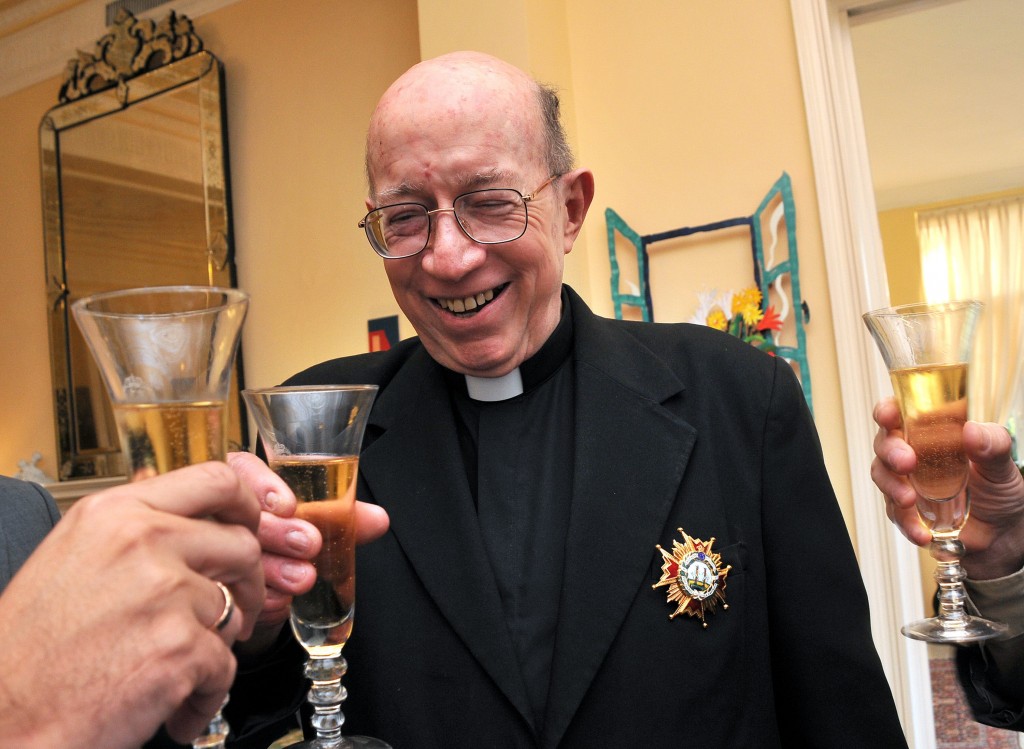
Partly because it was not reported widely, or, indeed, anywhere, and partly because it is impossible to keep a perpetual deathwatch over the thousands of traitors who have destroyed our country over the last 56 years, it is not surprising but entirely explicable that I did not learn until today of Msgr. Carlos Manuel de Céspedes' demise, which occurred on January 14, 2014.
The news, many years after the fact, that a dear one has died in Cuba — an experience common to all exiles — can still be a devastating loss, whether mourned in or out of season. It is not so when an enemy's death catches you unawares. Then you feel that you have been somehow cheated out of the comfort which such news affords; not for that reason, however, would you wish that it were not so.
On his grave, literally, was placed a wreath of flowers from Fidel Castro.
Msgr. de Céspedes has returned the compliment in the only way available to a dead man: he has stated in a posthumously published book, Monseñor Carlos Manuel se confiesa, which was presented today at the Havana Book Fair, that he is convinced that Fidel Castro will go to heaven because "he deserves to." Previously, Céspedes had expressed a similar conviction about the sanctity of Ernesto "Ché" Guevara in an op-ed in Granma.
This man was once the Vicar General of Havana and President of the Cuban Conference of Bishops.
He would certainly have become the Archbishop of Havana if he had not lived openly and infamously with his boyfriend for many years. A little more discretion, though not much more, is required to occupy that position.
Now, we all know where Msgr. de Céspedes is going; he was preceded there by Guevara and will be followed by Fidel.
But before he disappears completely in a cloud of smoke, let us invoke his hallowed name (the only hallowed thing about him) for one last time:
Bishop Agustín Román Bequeaths $60,000 to Castro's Church
Carlos Manuel de Céspedes III
Wednesday, February 18, 2015
The Stone Age in Cuba (1959-?)
"Wherever man is born abandoned and left to fend for himself, with no knowledge of what came before him, there the Stone Age shall begin again." — José Martí
"En dondequiera que el hombre nazca abandonado a sí mismo y sin conocimiento de lo que le ha precedido, comenzará otra vez la edad de piedra". (Obras Completas, 22:306).
Sunday, February 15, 2015
"José Martí in Tampa" by Cecil Charles
This is Cecil Charles' earliest known article on José Martí, whom she had met for the first time some months earlier. It is written from Tampa on the day of Martí's triumphal arrival there, which indicates that Cecil Charles may have arrived with him or was at least present to witness his apotheosis, though it is unlikely that she was there by happenstance. As in all future articles, she introduces Martí to her readers as a man of uncompromising principles who is ready at all times to sacrifice his own personal interests on behalf of his country's redemption. To illustrate this point, she uses the same example in all three articles: Martí's voluntary resignation of his lucrative consular posts in New York in order to devote himself entirely to the cause of Cuban independence. She describes his physical appearance in glowing terms, again alluding to his "pale, fine face," his "almond-eyedness, and "dreamy expression." She says in the article that she had personally interviewed Martí for it, and it is undoubtedly so. In no other contemporary account do we find such a wealth of detail on Martí's life, details that could only have come directly from his own lips. Others, too, may have heard him say similar things but only Charles paid to his words all the attention that was due them and faithfully recorded and preserved what she heard, letting us decide its import. We only wish she had been around him more, for no other friend of Martí's came closer to becoming his Boswell. For more than 100 years it was not known that Martí was elected as a delegate to a workingmen's congress in Mexico. Finally, Paul Estrade found a mention of Martí's early syndicalism in a socialist Mexican newspaper, which, of course, led to a spate of articles about Martí as "champion of the proletariat." Only someone profoundly ignorant of Martí's life would have supposed him to be something other than a champion of the rights of the oppressed. Charles also mentions another fact of which history has left no trace even in musty newspapers, that Martí was offered the position of personal secretary to a Mexican governor, which because of his "lack of worldliness" he had turned down much to his later regret. (Let's be grateful that he did turn down the "secretaryship" or otherwise he might have ended up as another Cuban ornament of the Mexican judiciary). Cecil Charles mentions also that Martí was president of the Spanish-American Literary Society, to which she herself belonged. On one recorded occasion, Martí read to the assembled literati of New York works by such well-known Hispanic poets as "Magariños Cervantes, of Uruguay; Salvador Díaz Mirón, of Mexico; Julián del Casal, of Cuba; and Cecil Charles, of Costa Rica," as reported in Enrique Trujillo's El Porvenir. Cecil Charles ends her revealing sketch of Martí's life and work with a highly characteristic quote, which summarizes both: "My life has two purposes; the second of them is the unification in spirit, and in accord with their nature, of the Spanish-American republics: to explain them, maintain them, and defend them without offence to the United States. I have faith in the United States, when she comes really to know our countries and people. I shall live and die for Cuba — to unite her scattered elements, in order that we may live in justice, peace, and liberty after the inevitable war."
JOSE MARTI IN TAMPA
Much Importance Attached to His Visit in Relation to the Cuban Question.
The New York Sun
November 26, 1891
Tampa. Nov. 25.— Señor Don José Martí, the noted Cuban orator, poet and leader, arrived this evening from New York, and was welcomed. by an immense crowd of Cubans and Americans, with a slight sprinkling of Spaniards as well. Señor Martí has come to Tampa upon tho invitation of the Ignacio Agramonte Club, whose guest he is. To-morrow night he will take prominent part in the grand political jubilee to be held in Ybor City. Although tired from his long journey he responded cordially to the warm greeting extended to him by his Tampa friends. The welcome took the form of an ovation of remarkable proportions, with bands of music and the wildest enthusiasm. Señor Martí will remain until Saturday. His visit is looked upon as highly significant in relation to the Cuban question.
When a man deliberately resigns a Government appointment with several thousands a year and honors in proportion, and smilingly lowers his forehead to the grindstone of meek and patient daily toil at the most prosaic of occupations, in order, as he says, "to preserve his independence," one naturally regards him as a singular sort of an individual. When Mr. José Martí, some weeks since, telegraphed his resignation of the Consulship General of the Argentine Republic in this city to the Minister of that country at Washington, it was not any complaint on the part of the Spanish Government had compelled the act but because he felt the necessity of relinquishing a post in filling which he considered himself trammelled in his labors for his country's independence.
Martí had not been guilty of violence in speech, as was at the time suggested by newspapers. This Cuban leader is a man incapable of violence in speech or act. Mild, magnanimous, and large hearted, Martí is a man of strange and varied experience. He is but 38 years of age, yet the first glance at his pale, fine face, the complexion strikingly white in contrast to the jet mustache and crisply curling hair, would cause one to believe him older. A noble forehead and a slight tendency to almond-eyedness give him a dreamy expression. He dresses in black and wears on his wedding finger a wide band of silver with a strain of iron through it. On the ring is quaintly carved the one word, "Cvba," by which it may be seen that the one great love of his heart is his country.
For a wonder I had an opportunity to converse uninterruptedly with Mr. Martí. As a rule his little office is crowded with callers from 1 until 4 o'clock. During these three hours all the thinking Cubans of the city seem to flock around him. and now and then a newly exiled General from Cuba makes his appearance. They fight the old battles over and plan new campaigns. Cuban independence will come, they believe. as surely as the sun will rise and shine. It will come before long very long. Fusion complete is what the agitators labor for. The enthusiastic demonstration in Tampa. in which not only the 2.000 Cubans of that city take part but the Americans as well, and even a few Spaniards, the first effort of the sort since the war of 1868, is in pursuance of these ideas of fusion and united strength.
Martí, who was born in 1853, was still too young at the time of that war to be condemned to death. But, youngster as he was, the Spanish Government found that his ready pen and silver speech were calculated to aid and encourage the revolutionaries. Martí. not l6, was editing a small newspaper, the Devil On Crutches. The Government could not send this tender youth, with the dreamy, almond eyes, out to be shot like a dog. but it could send him to the Political Penitentiary. Here, forced to go barefoot with chain and ball attached to his ankle.the boy was set to work in the quarry breaking stone. A tiny statuette was made of him appearing thus, and some of the Cubans in this city possess this interesting work of art. From 4 in the morning until sunset young Martí pounded away at his stone-breaking, and at the end of the first week his feet were torn so that he could hardly walk.
In that prison, says Mr. Martí, were political prisoners nearly 90 years old and negro children of 12; idiot slaves of 100 and white lads of 14. Later, when he had been sent to Spain, Martí published a pamphlet on these prison horrors, and asked that they be remedied. He described them and set the. Spaniards face to face with them, but in vain.
The young man then, became a student at the university ot Zaragoza, where he obtained the degrees of licentiate at law and bachelor of philosophy and of letters before he was 21. He started a school for poor and ignorant creatures in a humble suburb, and there dwelt, suffering constantly from illness contracted during imprisonment, but not subdued. His parents, self-exiled to Mexico, required his presence, and he went. There the young idealist found shelter and friends, but was not worldly-wise enough to accept a proffered secretaryship from one of the Governors. He was elected delegate to a workingman's congress, however, and there and then began his literary life in earnest.
Martí is known everywhere in Spanish America: more widely known perhaps than any other individual living. Not only is he known as an author, orator, and teacher but also as a friend to all the Spanish-American countries. From Mexico he went to Guatemala to accept the chair of philosophy and literature in the university. The war having ended in Cuba, he wandered back to his beautiful island home, but he was not long there when everything of a revolutionary tendency seemed to concentrate in his personality. This was quickly perceived, and the Government said: "He must go to Spain at once." However, they permitted him to wander about Madrid and he soon escaped. He came to New York to head the revolutionary Junta at about the time of Calixto Garcia's unsuccessful expedition. Garcia was unable to get the other important chiefs to ally themselves to him. and did not understand how to control the revolutionary elements. The forces were surrendered and the effort fell through. Martí arrived in time to explain the state of affairs and to save many persons from going to die when the sacrifice would have been useless.
After this Martí went to Venezuela. He would neither solicit nor accept any Government post from Guzman Blanco, but turned professor. He also founded the Venezuela Review. Then he came to New York, and here this remarkable man divides his time in hours of labor and hours of good works. Articles from his pen are eagerly sought by the Mexican and Central and South American journals. His mornings are devoted to literary work; his early evenings to classes in languages and literature. He is President of the Spanish-American Literary Society, and presides over its meetings on alternate Saturday evenings.
Every Tuesday evening, on leaving bis classes in Sixty-second street at 9:30, he makes his way down to a certain humble hall in Bleecker street, where is gathered a number of wonderfully intelligent young colored men intent upon educating themselves. Tired as he is, Mr. Martí is always happy to get to these honest and ardent young friends. They gather round him with faith and affection; they ask him all sorts of questions, historical, moral, sentimental, political, physiological, theological, metaphysical. He comes in with his pale, smiling face and his wonderfully magnetic presence, like an animate encyclopaedia, and he does not leave until nearly midnight.
"My life." says Mr. Martí, "has two purposes; the second of them is the unification in spirit, and in accord with their nature, of the Spanish-American republics: to explain them, maintain .them, and defend them without offence to the United States. I have faith in the United States, when she comes really to know our countries and people. I shall live and die for Cuba — to unite her scattered elements, in order that we may live in justice, peace, and liberty after the inevitable war."
Martí is a man of modest and almost ascetic life. The jubilee welcome extended him by the Tampa people was unsought by him, and undesired save as an expression of progress of the movement toward independence. The Cubans in New York are at work quietly and intelligently. Gens. Maceo. and Flor Crombet bide their time in Costa Rica. "No annexation, but independence," is the watchword. It is only natural to suppose that Martí will be chosen President of the new Island republic.
CECIL CHARLES
This article was graciously provided to us by Professor Jorge Camacho.
Friday, February 13, 2015
Cecil Charles Blog
Does Cecil Charles (aka Lily Curry Tyner), Martí's friend, translator and self-acknowledged "lover," deserve her own blog?
Deserve it or not, she has one:
Cecil Charles Blog
I think she would be pleased that her blog and Martí's are hosted by the same individual, a fellow translator of the Versos sencillos and one of the few people living today who knows her name and is acquainted with her life and works.
I should ask no more for myself in the inscrutable future.
Sunday, February 08, 2015
"The Leaders of the Cubans" by Cecil Charles

"Martí as a Lover," which we contend was authored by Cecil Charles, has received much favorable comment from academics and other martianos. Although I believe (and they believe) that I have made my case, and I do not as rule revise published posts except under rare circumstances (that is, when I have incurred in an error of fact), I have thought it best, nonetheless, to present new proof that I was not wrong. This article by Cecil Charles, published in The Sun on March 29, 1895, which we have rescued from undeserved oblivion, anticipates and could be called the "prequel" to "Martí as a Lover." It is useful in that it helps to establish the parentage of the unacknowledged child by its resemblance to the acknowledged one. Here Cecil Charles recounts her personal recollections of not only Martí, but Antonio Maceo and Francisco "Flor" Crombet. Cecil Charles, it would appear, never met a Cuban man that she didn't like. Martí, Maceo and Crombet represent all possible types of homo cubanis (at least until the Chinese-Cuban was incubated). There is much to like and admire about Cecil Charles in this article: first and foremost, her unqualified support for the Cuban rebels and belief in their inevitable victory. Perhaps Martí did help her find her better angels. Cecil Charles was truly a woman ahead of her time, and this is clearly shown in her treatment of Maceo and Crombet. What she admits in this article no single white woman in the 19th century would have dared to do much less admit: she invited the Afro-Cuban patriots to visit her home. She uses the pseudonym "Cecil Charles" in her article, which, of course, is a man's name (Cecily or Cecilia would have been the female equivalents). Although she does not write like a man and can easily be distinguished as a woman, her pseudonym is sufficient cover for her subversive socializing. Finally, Cecil Charles presents in this article one of the most touching contemporary evocations of José Martí, and certainly the most interesting by a woman with the exception of Blanche Zacharie de Baralt's. Of special interest is her description of Martí's personal library in his office at 120 Front Street, New York. His widow, Carmen Zayas-Bazán, disregarded Martí's request, contained in his "Literary Testament," that a catalog be prepared of his books before their disposal, and, instead, had them packed up and shipped to Mexico for sale, where they were subsequently lost (and with them Martí's invaluable annotations in almost all of them). A score of random books, however, which he had kept at Carmen Miyares' house, were saved and eventually found their way to the Havana Historian's Office, where presumably they are still kept. Among eleven books in English (of what once must have been hundreds if not thousands) was found Cecil Charles' Honduras: The Land of Great Depths (Chicago and New York: Rand, McNally and Company, 1890).
LEADERS OF THE CUBANS
Men Who Are Foremost in the Struggle for Freedom.
Maceo's Colonization Scheme — Crombet as a Fisherman — Martí's Patient Labor of Love in Organizing the Patriotic Cubans.
The New York Sun
March 24, 1895
The first time I saw Gen. Maceo, the dauntless Antonio Maceo y Grajales, for whose coming the Cuban insurgents hiding in the hill ranges from Santiago all the way up to Puerto Principe and beyond are waiting and praying, was about four years ago, in Costa Rica. I was breakfasting in a hotel at San José, that white jasmine-like city that lies in one of the most beautiful valleys in the world, the Aserri paradise, extending from the indigo shadow of the volcano Irazu to the exquisite sapphire Candelarian hills. A tall man entered in ordinary citizen's clothes, a mulatto at the first glance, but clearly a person of distinction. As I knew almost every one in the city and almost every one knew me as an American and a correspondent it was not long until I made the General's acquaintance.
Exquisitely neat in appearance and perfect in breeding, with a certain reserve and modesty of bearing, he could not fail to interest one who had heard of him as a brave young leader In struggle for his country's freedom twenty years before. General Maceo was in Costa Rica looking for a colony site and a Government concession. He was not exiled there, or in any way under Spanish surveillance, as one might believe from reading a recent Tampa despatch to the effect that the Spanish Consul had been removed for allowing Maceo to escape. He was there to see about locating a colony of his countrymen. He wanted a site on the Atlantic side, that coast being time more accessible, but he had to take what he could get up in the peninsula of Nicoya on the Pacific. The Costa Rican Government gave him as its reasons that too many other enterprises had first choice on the Atlantic coast. But the General let me into the secret of his suspicion that the Spanish Government had requested Costa Rica not to give the proposed Cuban immigrants, who would naturally be revolutionists, a too advantageous site for the embarkation of an expedition at short notice. Maceo finally accepted the remote lands and entered into a very interesting agreement with the Minister of Fomento (Public Works), by the terms of which he promised to bring into the country some five hundred and ultimately a thousand Cuban families — no negroes to be admitted. Just how much regret Costa Rica may feel at the loss of this colony, which would have been an undoubted benefit to the country and which in the event of a long-continued war in Cuba will be postponed and in the event of a successful revolution be abandoned, it is hard to say.
I believe Maceo was in earnest in trying to get the contract. He had given up hope of another struggle for years to come. Pacific and suave he went about the streets of San José attending to his business, like a man who had never been wounded, or driven to hide in mountain fastnesses and starve there for days, or to escape in a small boat by night and drift out to sea to lie, festering and delirious, under the burning tropical sun. Cuba's freedom was only a question of time, he said calmly. The only time he showed any excitement was when news came of Flor Crombet's escape from Cuba and the confiscation of his property. Then General Maceo got himself ready in short order and went down to hot Port Limon to meet his brother warrior. They came up to the capital together, and I had the pleasure of receiving the two big fellows at my home.
Flor Crombet is a man one couldn't help liking — frank as a boy he admitted he didn't care to go into Gen. Maceo's colony scheme, but he thought he would stop a while and see the country — his complexion showed nothing of the African, but suggested Indian blood. He had a direct honest glance and the pleasantest way in the world. The scar on his face seemed to want to apologize for being there ahead of time — that is, before Cuba is a country. To amuse himself and make a little money he bought a fishing smack and set to work catching fish along the coast by Limon. Now, the sea along the coast is the nastiest bit of water for making one repent that one could imagine. There is a horrid choppiness all the way down toward Bocas del Toro — but the fish are certainly fine. Crombet sold all he could catch and nobody appeared to think he could turn his boat to expeditionary purposes. He was unmolested and cheerful as a school child. Occasionally he came up to San José — and Maceo and he certainly made a fine-looking pair. Nobody ever saw them engaged in any mysterious conference or plotting. Maceo was very friendly with a family that had lately come from Cuba, a Spanish family, or, at least, loyal to the Spanish rule, for the Spanish Minister was also a great friend of theirs, and Gen. Maceo and he must have met very often at the house. The meetings were without the slightest annoyance or feeling on either side, I am confident, for Señor Arellano, the Minister, who is now in Guatemala, I think, is a most delightful man, and Maceo was also delightful in a social way. Only it seemed a little odd that they should meet thus.
Gen. Maceo was a little older than Gen. Crombet, but the two offered a strong combination — Maceo reserved, astute, far-sighted, of unguessable thoughts; Crombet outspoken, earnest, enthusiastic, daring. From a personal knowledge of the pair, I should say that if they are really on Cuban soil it simply means that the astounding success of the revolutionists may be looked for. I say astounding success because such a victory against such terrible odds should astound the world. Maceo would never waste his life or Crombet's; if they are in Cuba, it means the beginning of the end.
Carrillo and Sanchez I met at a steamer on my return to New York not long after, where, with the patriot Marti, they were seeing off some Cuban friends bound for Costa Rica — Carrillo affable, full of hope and good spirits, in appearance more Saxon than Latin; Sanchez pale, serene, contemplative, with these words on his lips:
"I can assert without boasting that our [last] war first with all its miseries and dangers and our defeat afterward with all its sorrows and losses, have only succeeded in making me stronger in my belief. The task to which I have consecrated myself for twenty-five years I shall not desert today at forty-seven What I cannot do is to leave my country in slavery through my indifference and lack of patriotism."
Sanchez was pale and still suffering from the wound in his leg from the bullet that killed the horse he rode when fighting under Gen. Roloff in 1876. I have before me a little book he has written, "Humble Heroes." The simple tales of Cuban patriots, told with pathos and modesty, are part of the revolutionary propaganda, which has attained to splendid proportions here in New York and wherever else the Cubans await the day of their deliverance. The network of clubs and leagues stretching from New Vork down to Tampa and Key West is perfect. It has been woven patiently and with consummate art. There is not a weak spot in it. José Martí has taught his followers how to weave it.
Is Martí with Maximo Gomez in Cuba? is asked. I hardly think so. Martí's sword is his pen, a weapon that will do more for the cause than many swords, perhaps. Once, five or six years ago, it was my privilege to be a pupil of this remarkable man. At that time he had just resigned several important and lucrative South American Consulships rather than desert the Cuban cause, and was quietly pursuing life as patriot and teacher. The cosey office now occupied by the revolutionary paper, Patria, at 120 Front street, was then his headquarters and the scene of many exciting patriotic meetings. Pupils, like myself, who studied there with the "maestro," as he was affectionately called, can never forget the place. I never saw another room so full of books. There were shelves to the ceiling, and movable bookcases and tables and chairs loaded down with books and magazines and papers. All languages were represented in that precious collection, which had not a single worthless volume in it. The maestro was still young; not tall or strong looking. Pale, with refined features and slightly almond-shaped eyes, he seemed the typical poet-exile from sunnier lands. Sensitive and easily moved as a woman, affectionate with friends, courteous to strangers, and always willing to give information whether it was the question of the best part of South America to immigrate to, or where to find a pipe to drink maté tea through, important and trivial people were all kindly treated.
Martí was an easy writer, but a painstaking one. He used to work feverishly away for hours over a single article, whether intended for publication or discourse. His cheeks would take on a brilliant flush, his eyes would gleam, and his entire frame tremble with excitement as sheet after sheet slipped out from under his hand. No one who ever heard Martí as orator before the wild crowd of his countrymen and sympathizers assembled in Hardman Hall on a memorable 10th of October could ever forget the elegant flow of thought, the fire, the poetic imagery, the insistent cry for liberty.
Martí was a busy man: besides earning his bread as a teacher he must also teach others as a labor of love. I remember a class of fine young fellows that used to meet in Fourth street. At their head was Rafael Serra, a young Cuban negro, quite black; a fellow of great talent. In the class were Cubans, Puerto Ricans and others. The maestro took more delight in instructing these eager and earnest young men than in all the adulation of the fashionable clubs that sought him as a notable speaker and thinker. Martí's literary work has been considerable. His translation into Spanish of Helen Hunt Jackson's "Ramona," his own poems, "Ismaellillo" and "Versos Sencillos," place him in a high rank. Martí has been spoken of as possible President of the Cuban republic. He would be no unworthy figure at the head of a new nation. But at present where is Martí, and where is the redoubtable, the faithful, the invincible Maximo Gomez? If they, too, have landed in Cuba, the end of the struggle must be at hand.
CECIL CHARLES
Wednesday, February 04, 2015
Sen. Jeff Flake Insults Arizona's Cuban-Americans in The Times
"I took a poll of Cuban-Americans in Arizona, and both of them said, ‘Go ahead'" [with your shilling for the Castro regime as an unregistered agent of influence]. — Senator Jeffry Hock Flake, quoted in The New York Times, Feb. 4, 2015
Well, if Senator "Jeff" Flake is going to be elliptical, I reserve the right to finish his unfinished sentences for him. I suppose that he would prefer "Go ahead" with restoring diplomatic ties with Cuba and scrapping the trade embargo, but that is altogether too humble and conveys no idea of his central role among Republican appeasers of Castro in Congress.
Mr. Flake is wrong, of course. There are not two Cuban-Americans in Arizona, but 10,692, constituting 2 percent of that state's population, or three times their representation nationwide (0.63). Of the 50 states, Arizona's Cuban-American population is the 13th largest in the country. The Arizona senator must think he represents North Dakota with its 265 Cuban-American or Wyoming with its 275.
Can you imagine what The Times' reaction would have been if Flake had said, "I took a poll of Jewish-Americans in Arizona, Barry Goldwater's family, and decided to support Jews for Jesus." (Not that there is anything wrong with supporting Jews for Jesus).
But it's OK to insult, belittle and discount Cuban-Americans even if they are your constituents. It's not like 10,000 votes could settle any race in Arizona, right?
According to Census Bureau estimates, "Jeff" Flake's hometown of Snowflake, AZ (yes, it's named for his family) has a population of 5,564, which means that there are almost twice as many Cuban-Americans in Arizona as Snowflakers. I'm not suggesting it, but I bet that if the local Cubans all moved to Snowflake, the Flakes would quit their ancestral home and move to Utah.
For the last 150 years, the Flake family has held virtually every elective office in Snowflake and sent numberless Flakes to the Statehouse and to Congress. It's like a miniature Cuba if you were to add 100 more years to the Castro dynasty. It is easy to understand why "Jeff" Flake feels such empathy for Cuba's rulers and it really has nothing to do with the Church of Latter Day Saints' desire that Raúl Castro legalize their religion in Cuba and allow Mormon missionaries to proselytize there for the first time since 1959.
We take Senator Flake at his word when he tells The Times that the right of Americans to carouse in Cuba and thus underwrite the Castro regime trumps the Cuban people's right to be free. We won't even ask him to show us where exactly in the Constitution the founding fathers bestowed that inalienable right on their fellow Americans.
One final observation: Do you think, as I do, that "Flake" is a bad name for a senator or any human being, and that sensible people bearing that name through no fault of their own should change it just because they can? In Cuba, it is not allowed for anyone named "Fidel" to change his name (and a great many Cubans were named Fidel around 1959). There is no law in Arizona, however, that compels the Flakes to remains Flakes forever. Why not just adopt the name "Snow?" That's flakey enough.
A Republican Joins Obama in Seeking Ties to Cuba
"MARTI AS A LOVER" by "Marie Desquez" [aka Lily Curry Tyner]
The pseudonymous "Cecil Charles" was José Martí's first English-language translator and the first to translate Martí from Spanish into any other language (previously Charles A. Dana, editor of The New York Sun, had translated Martí from French to English and Adriano Páez from English to Spanish). Appearing in 1898, just three years after Martí's death, Cecil Charles' partial translation of the Versos sencillos (seventeen complete poems and fragments from three others), would remain the only specimen of Martí's writings available in English for more than 50 years (available, specifically, in three places: the Library of Congress, the New York Public Library and the Buffalo (N.Y.) Free Public Library). Also adding to its obscurity as well as its fascination her selection of Martí's poetry was published with the suggestive title of Tuya and included a generous selection of her own original verse, which if nothing else clearly delineated the difference between simple and simplistic. There is a great deal more Cecil Charles in this book than José Martí: only the last ten pages of this 75-page volume are devoted to Martí's poetry, though even with those odds Martí is not at a disadvantage. It would be unfair, however, to accuse Cecil Charles of riding on Martí's literary coat tails because those coat tails were not especially long in 1898. Her desire to be associated with Martí had another more personal motivation. She had been friends with Martí (and perhaps something more) since attending his Spanish classes at New York's Central Evening School, where Martí taught from 1890-1892. Her interest in Martí's poetry also dates to that time. With his assent and assistance, she had been engaged in translating his poetry even before the publication of Versos sencillos (1891). In a notation preserved among his miscellaneous papers, Martí recorded an instance of their collaboration. He jotted on a card an improvisation and handed it to her. Immediately, as he noted, she translated the quatrain on the same card and handed it back to him:
Flor de azahar! —
La que perfuma el alma sin quemarla:
La flor de la amistad. —
There is a flower purer than white
Orange-flower: —
Which perfumes the soul without burning it:
Friendship's flower. —
Cecil Charles was an excellent translator when not shackled to rhyme; but, like most people, she did not preen herself on what she did well, but sought to excel where she was challenged — to the point of putting Walt Whitman's free verse into rhyming couplets (was she the first or only one to try?). A respectful review of Tuya appeared in The New York Times grouped with other books about the war in Cuba. The reviewer, Joel Benton, author of Emerson as a Poet, could not have been more ideal. He assumed that the author was a Cuban woman. Of her renderings of Martí's poetry, he diplomatically observed: "It looks as if the delicacy of the Spanish phrases has not been easily put over — if at all in some instances — into our heavier English; but here is an aspiration that meets the sharp test of a burning patriotic fervor." He quoted two more or less credible examples. I prefer to quote two which are decidedly not because they are more representative:
At the vineyard gate and a bee
Flew under the dainty hood
Of my little one — ay, ah me!
With a joy of joys tremendous —
When the jailer read me weeping
The sentence of death stupendous.
Herself an author and protegé of the celebrated poet Ella Wheeler Wilcox, Cecil Charles no doubt proved fascinating to Martí. She is in fact the only norteamericana that Martí is known to have befriended. When discussing the women in Martí's life, Cecil Charles' name is invariably brought up by his biographers as the only American woman linked romantically to him in the 15 years that he resided in this country, although until now there has been little basis for such a conclusion except for Tuya itself, the joint anthology — or poetical marriage — published under a man's name by Lily Curry Tyner (her almost real name).
Besides her literary affinities, Lily Curry had other attractions which would not have gone unnoticed by someone with Martí's exquisite sensibility to beauty. In a profile of female authors entitled "Beauty and Brains," this how Lily Curry is described around the time of her association with Martí:
"[She] is said to be 'the prettiest literary woman in New York.' She is young and industrious, but occupies herself chiefly with newspaper work of a critical and editorial character, If half the articles she has written for various newspapers in the past two years had bore her signature she would be famous. She has written some very clever stories besides, which have attracted the attention of high literary authorities... She has large hazel eyes, chestnut hair, and perfectly chiselled features. Her beauty is clearly spirituelle. Like Ella Wheeler Wilcox, she is exceedingly fond of children... The most striking qualities of these two women, it may be remarked, en passant, are their love of truth, loyalty to friends, and absolute freedom from petty jealousies common to their sex."
This character portrait, incidentally, was written by another woman, Fannie Mack Lothrop, who was really free from "petty jealousies common to their sex," and except for its attestation to her physical beauty and industriousness, does not offer an entirely accurate depiction of the far more complicated Curry.
In 1898, when Tuya was published, it would have been a bold if not reckless act for a woman to imply even in another language an illicit relationship with a married man, especially if that man were dead and his survivors forced to address the accusations. Lily Curry was in fact very bold and reckless — what the Victorians called "a woman with a past" — but she did not want to offend Martí's family or alienate his friends, and she found a way to make her Tuya acceptable to them and the prevailing mores while still laying her claim to belonging to Martí. And she succeeded admirably, even with Gonzalo de Quesada, the appointed custodian of Martí's archives and self-appointed guardian of Martí's good name, who puffed her book as "one that every Cuban patriot should own." How did she do it? Ingeniously, in the introductory poem ("Tuya. A Memory from the Cabañas Prison"), "Cecil Charles" explains that the title refers to the tuya plant (or thuha occidentalis):
Cedar or what? No botanist am I —
I only know that maidens give it blent [blended]
With bud or blossom to the suitor shy
Or diffident slow sweetheart, and he knows
That he may hope and speak...
Clearly, Martí was not going to speak now. The suggestion is that he never did speak and was, at best, a "suitor shy" or "diffident slow sweetheart." Of course, Martí was neither of these things. He did "hope and speak" but the "maiden" was deaf to all his entreaties. According to her own account (written in the third-person and published anonymously eight weeks after his death), Martí was madly in love with her and she offered fragments from his love letters to prove it. Those letters carry the unmistakable imprint of Martí's style even in English translation and could not have been written by anyone else — that much is certain. As for Tyner's veracity in other respects, it is highly suspect as she appears to have been a Walter Mitty-esque character who routinely turned reality on its head to suit her purposes.
Before entering Martí's life, Lily Curry had been involved in an adulterous relationship with a man named Michael P. Tyner, whose last name she took though they were never legally married. Tyner, the literary editor of The New York World and Joseph Pulitzer's private secretary, met Curry when he was sent to "interview an authoress from the West, who was stopping at a city hotel." The two fell instantly in love and ran away together to Honduras, where Curry later claimed to own gold mines. On his return, Tyner's wife had him arrested for abandonment of her and their two children. Chastened by the public scandal, Tyner quickly reconciled with his wife and returned home, where he fathered a third child before again absconding with Curry, this time to London. On returning six months later to New York, Tyner was again imprisoned for abandonment and his wife sued him for divorce, custody of their three children, and alimony. He contested the alimony.
Contentious divorces (or divorces of any kind) were front-page news in the 19th century and the Tyner divorce in particular was covered by all the New York dailies (including his own) because of the startling defense put forward by the defendant. Tyner claimed that his wife was in fact not his wife because he had previously been married to Curry from whom he had never obtained a divorce. To avoid being charged with bigamy, he said that he married his second wife under the assumption that his first had died. Supposedly, Tyner and Curry had wed as teenagers, but her aunt and guardian, who disapproved of the match, had separated the couple after ten days and taken 13 year-old Lily to live out West, later informing Tyner that she had died. Miraculously, the two found each other again when his paper sent Tyson to interview the "authoress" and she turned out to be his lost child bride. The fact that his first wife was still alive, Tyson contended. meant that his second marriage was not valid nor his putative second wife entitled either to a divorce or to alimony. Lily Curry backed up Tyner's story in several affidavits (or, just as likely, Tyner repeated Curry's story as she dictated it in her affidavits). On scrutiny, however, this tale of a latter-day Romeo and Juliet fell apart at the seams: neither Tyson nor Curry could produce the marriage certificate; the marriage was not recorded in New Jersey (where they claimed to have been married); and there were no witnesses to the marriage nor anyone with any recollection of it besides themselves. Tyner eventually recanted the story; Curry never did.
In granting the petition for divorce, Judge Donohue took special aim at the "alleged authoress Lily Curry" and "her attempt to impose upon the court," which, if she had prevailed, would have resulted in Tyner's children being declared illegitimate and wards of the state. Donohue ruled that he was "satisfied, after a full examination of the case, that the affidavits by and on behalf of the defendant are wholly devoid of truth. At the first hearing of the case the evidence on the part of the defendant, who called this alleged first wife as a witness, was that she had no interest or connection with Tyner except an interest in his welfare and a desire to aid both Mr. and Mrs. Tyner in arriving at an understanding. Mrs. Curry's subsequent affidavits entirely ignore this statement without any effort to explain it. There is nothing in Mrs. Curry's statement that is consistent, or on which any reliance can be placed. The story which she tells is full of inconsistencies, and is contradicted by other evidence in the case. It seems to me, therefore, that but one result can be arrived at, and that is, that the effort to make out that she was the first wife of the defendant has wholly failed." He ordered, moreover, that the evidence of their perjury be sent to the District Attorney in order that they might be prosecuted for their acts.
Lily Curry (aka Tyner) found it expedient to leave New York at once and returned to Chicago under an assumed name, "Miss Paul Rochester," an old usage that meant "the unmarried daughter of Paul Rochester." Her alias was soon discovered by the local press when she wrote a series of articles on Honduras and (another) reporter from The New York World was sent to interview her. Although presented with irrefutable evidence of her identity and confronted on the spot by a local reporter who had known her as Lily Curry, "Miss Rochester" refused to admit that she was Curry or that she had ever known a Michael Paul Tyner. When asked if she had not once eloped with him to Honduras, she replied: "Oh, no. What a fool a girl is to elope. I never eloped with anyone. What does all this mean? Who has been telling you stories about me? I am, just as I told you, an orphan girl who went to Honduras for business and pleasure and had some strange experiences there." The more insistent the questioning, the more hysterical Curry became. Her answers indicated that she was either temporarily detached from reality or alienated from the truth on a permanent basis, something which we must consider when evaluating her later claims about Martí.
The article in The World was the last time that a story about Curry appeared on the front page of a New York newspaper till Tyner was re-arrested three years later, in 1891, for non-payment of alimony, when the details of the Tyner divorce were once more brought to the public's attention but not as prominently as before. By then Lily Curry had returned to New York, if not quite in triumph, at least without fear of prosecution, and enrolled in a Spanish language class taught at an adult evening school by a Cuban professor named José Martí, who may or may not have known about Curry's interesting history. In any case, it didn't stop him from falling in love with her as impetuously as Tyner did. If Curry was not the great love of Martí's life, she was the last woman that he loved passionately and pursued unwisely (as even Curry admitted). In this case, however, unlike in the Tyner divorce, Curry was able to produce the "goods" — love letters from Martí that bore witness to the smoke if not the fire.
The article which Curry wrote about Martí's love for her was syndicated in numerous newspapers, including The Burlington Gazette (Iowa). The Globe-Republican (Dodge City, KS) and The Ironwood News Record (Michigan). It was sensationally headlined "MARTI AS A LOVER." The sub-headlines expanded on the theme: "The Cuban Patriot Loved Unwisely. His Reported Death at the Hands of the Spaniards Occurred on the Same Day on Which the Woman to Whom He Was Devoted Was Married to Another — The Man's Romantic Career." The article was first published on July 18, 1895, or two months after Martí was killed in Cuba. The information which it provides on his personal life and career is found in no other article of the hundreds published in the wake of Martí's death in the U.S. press: such as the fact, not known to historians until recently, that Martí had been tipped off by a friend that Spain was going to lodge a formal protest with the governments of Argentina and Uruguay on account of their having the leader of the Cuban insurgents as their diplomatic representative in New York, which led Martí to resign by telegraph his consular positions "before either country had the chance to remove him," thereby denying the Spanish government a complete victory. Also, the author recounts Martí's pride at "his having spoken in public in one of the great Tampa meetings — in English" (fragments of his remarks are preserved in his notebooks and nowhere else).
This unsigned syndicated article echoed a signed one published three months earlier in The New York Sun above the byline "Cecil Charles." In that earlier article, "Leaders of the Cubans" [March 24], she extolled three men of the revolution whom she had known personally — Antonio Maceo, Francisco ("Flor") Crombet, and Martí. The first two she had met in Costa Rica in 1892 when she was sent there as a foreign correspondent (she does not say by which newspaper, but presumably not The Sun). On Martí she dwells the longest, and the first thing that she says about him, after explaining how they met, is that this "remarkable man" had "resigned several important and lucrative South American Consulships rather than desert the Cuban cause," which selfless act she would also highlight in "Martí as a Lover," as we've just seen. She describes Martí as "still young; not tall or strong looking. Pale, with refined features and slightly almond-shaped eyes, he seemed the typical poet-exile from sunnier lands ... sensitive and easily moved as a woman." While "work[ing] feverishly away for hours over a single article" — or perhaps while engaging in other creative acts — "his cheeks would take on a brilliant flush, his eyes would gleam, and his entire frame tremble with excitement." To stare at Martí for hours while he was writing, observing his physical reactions — which appear to mimic coitus — or just to be able to spend hours on end with him at the height of his revolutionary activity when everybody wanted a part of him and nobody got all that they wanted, is itself an admission of singular closeness, not to say intimacy.
Certainly, there is not much of a leap from "Leaders of the Cubans" to "Martí as a Lover." The anonymous article — no less than the pseudonymous one — was clearly written by someone with a profound knowledge of José Martí such as could only have been acquired from a close acquaintance with him. It references specifically the two years that Martí worked as a New York City schoolteacher and purports that it was in his classroom that he met the "woman he loved passionately," supposedly a well-connected orphan of Spanish descent and high artistic attainments identified as "Marie Dezquez" (there is no one of that name in the historical record). This student of "Spanish descent" with a French name who enrolled in Marti's evening class to learn or hone up on her Spanish was, along with Mrs. Lily Curry "Tyner" and "Miss Paul Rochester," another alter ego of the woman remembered today (if at all) as "Cecil Charles." Disguised as "Marie Dezquez," Curry related the history of her relationship with Martí and everything she says about it rings true. She omitted, of course, the fact that she had translated a score of Martí's poems, because that would have made her too recognizable when she published them, as she intended to do, three years later. She did, however, translate extracts from Martí's personal letters to her, which, as has been already noted, cannot be attributed to anyone but Martí. Besides the shared style there are other identifying markers which have been ably pointed out by Jorge Camacho in ¿Otra amante de Martí? Professor Camacho has also re-translated Martí's letters back into Spanish and I will not duplicate his admirable efforts. It is interesting that, without solving the mystery of who wrote "Martí as a Lover," Camacho was convinced of the authenticity of the letters attributed to Martí in the article on the strength of the letters themselves. If it were proven that Cecil Charles was not the author of the article, I, too, would persist in the belief that Martí was the author of the letters.
Curry's translations of Martí's letters are magisterial and one wishes that she had devoted herself to rendering into English his prose rather than his poetry. Fluency in Spanish was not common in 19th-century American newsrooms as evidenced by the fact that Martí was obliged to write for The Sun in French in order for his articles to be translated into English. Whoever provided Martí's letters would also have had to furnish the English translations of them, and that is something which only "Cecil Charles" could have done or would have been inclined to do. In both her translations of Martí's poems and his letters she uses the antiquated (or artificially distressed) pronouns and conjunctions of Shakespearean English as imitated in the 19th century, such as "thou," "thee," "thy," "thyself," "shalt," "mayst," and the "est" ending attached to verbs, etc. Obviously, for Curry, this episode in her life was another re-enactment of a Bardic tragedy.
Did it really matter to Curry if she were found out? Does not the mere existence of this article (or confession) indicate a desire on her part that the truth (or her truth, anyway) be known some day? If she had written nothing about Martí her secret would have been safe for all time. There are messages that are sent into the world in glass bottles, leaving to chance or providence whether their contents are ever known. The process of releasing them on the currents of history is itself an unburdening. Perhaps that was enough for Lily Curry. If, however, she secretly desired (as I believed she did) that the real identity of Martí's last love be discovered and revealed to the world, she left enough clues to make that possible.
So much for the factual and verifiable elements of Curry's account. Then there is her contention that Martí was killed in Cuba on the very same day — if she were writing at the height of the Romantic era rather than in its waning days, she would have said "at the very moment") when Curry herself was being married to "the man (Tyner) who caused [her] so much pain," as Martí had predicted. That marriage certificate, also, has never been located.
Before we judge Cecil Charles harshly for anonymously publishing an ephemeral third-person article on "Martí as a Lover," containing personal letters from Martí that had become her property (the letters and their contents) upon Martí's demise, let us remember that Martí himself had, at different times, projected writing memoirs of his sexual adventures, variously titled "Mis Mujeres," "Mis Conquistas," "Memorias amorosas de un hombre sincero" (I kid you not), and, finally, "Las catorce aventuras amorosas de Hipólito Martínez," which he, too, intended to write under a pseudonym. The worst that Cecil Charles may have done is to anticipate her own chapter.
MARTI AS A LOVER.
THE CUBAN PATRIOT LOVED UNWISELY.
HIS REPORTED DEATH AT HE HANDS OF THE SPANIARDS
Occurred on the Same Day on Which the Woman to Whom He Was Devoted Was Married to Another — The Man's Romantic Career.
On the day that Jose Marti, the Cuban revolutionist, is said to have fallen with a gaping wound in his throat, the woman he had loved passionately but hopelessly was married to another. He had first met her in New York City, where she had been one of his pupils. She was of Spanish descent, an orphan, well connected, a clever musician and an amateur song writer. Marti had been recently appointed Consul for Argentine and Uruguay in New York, but he continued to teach Spanish history and art. A widowed mother and several sisters in Cuba were dependent upon him. and he was compelled to employ every means to secure a sufficient income. Scarcely had he familiarized himself with the duties of his Consulship when the agitation for Cuban revolution broke out. Clubs were formed, meetings were held and Marti, plunging into the movement, became almost immediately its recognized head and front. Then came a demand from Spain that the South American republics which had given Marti his Consular post should have as their representative some one other than an agitator and leader of Cuban Insurrectionists. Marti, warned secretly by a friend, sent in his resignation before either country had the chance to remove him. "I no longer represent any country," he said; "I am henceforth only a Cuban patriot."
At that time Marie Desquez, the young woman in question, of Spanish descent though she was, showed Marti a sympathy which won his heart. It was a hopeless passion from the start, and he must have recognized it as such. He had a wife and child in Cuba, but although he had been estranged from them for years, the young woman, aware that he was not free, possessed too fine a sense of honor to respond to his love, had she felt an equivalent affection for him. This she did not feel. A previous attachment to a man from whom she had been temporarily estranged and whom she afterwards married, controlled her throughout her associations with Marti. Whatever may have been the attitude of the revolutionist towards her, she consistently assured him that she could never consider him more to her than a friend. A day came when she was led to believe that some sorrow might come to their continuing to see each other, and when he called on her one afternoon she bade the servant say that she had gone away. Then she stood and watched from behind the curtain with tearful eyes. She did not see him again until two years after, when they met by chance in a public place, and he spoke to her of his life work and of his having spoken in public in one of the great Tampa meetings — in English. He did not know, he said, how much power had come to him, but he believed it was because he had been thinking of her. "Yo te quiero — ;yo te quiero!" he exclaimed, and then they parted for the last time. But in those months of their acquaintance Marti wrote many beautiful letters to the young woman letters which, even in the translation, bear many characteristics of his refined and poetic nature. In one of them he said:
In the shadowy corners of my room there seems to whisper, as if softly disputing with the empty air, a little voice that troubles me. Within me, like a song, I hear a voice that now I never shall cease to hear. I know, alas, the realities of life and the terrible impossibilities of arranging it to meet the desires of a noble soul; and a compassionate man may live to my years without being burdened with slaveries and anguishes. But I know also that life is impossible — and more frightful than any death could be — if one must live with the soul in solitude — with the great and tender soul in solitude, and with every hope shattered and falling to the earth like a flag rent in pieces. I know that if one would live out one's life with dignity to the end. although one may not know the greatest happiness, it needs that another soul come in the hour of agony and of despair to console and strengthen and to give new life to our own. I would never be an instant at thy side if I believed I wrought thee any. harm. I feel that I could bear thee as a little wounded bird in the palms of my hand. And again I see thee as when we parted last parted —walking slowly, slowly, as if reluctant to leave me, and each step of thine is as a kiss. For after knowing me thou shalt suffer less; never even in thy greatest loneliness shalt thou feel thyself alone. Thou shalt turn to me and live day and night in my heart — as a bird in its nest. I have seen the birds in their happy nests in the depths of our mountains, and thou recallest them to me. The happiest life that is possible in the world is that of love and of work. This life as natural as the sunlight: would that it might have been ours! But still one may know sufficient of it to sustain and give courage for the rest of one's life. Thy desire to see me today, thy pious and eloquent desire, reveals to me that between thee and me is that strange and divine power born only of the exchange and union of two suffering souls. Thy face is before me, and I seem to feel myself filled with the light of thine eyes. And here, with soul newly kindled, here I sit in my empty room;
Worldly wise — in other words, filled full to the lips with principle and the decorous ideas of the world — the young lady felt that she could not afford to give this great man any affection that might at any time be turned to reflect unpleasantly upon her. She had had her own romance, and was somewhat cynical and incredulous. She was capable of bitter remarks at times, even to Marti, for whom she had a profound reverence. She would never marry; she would believe in no man as a lover. And with an increasing sense of right and conventionality on her part and of hopefulness and of misery on his, the romance of Jose Marti dragged to an end. In his last letter to her he said: "It may be that you will love some one; it may even be that you will be reconciled to the lover who caused you such pain before we met. It may be that you will believe in him again, and consent to unite yourself to him for life. And when that time comes remember I have told you this — I shall be lying dead with a bullet of the enemy in my suffering heart. And so I shall not grieve; and thou mayst be happy."
Saturday, January 31, 2015
Notable & Quotable: Wisdom from The New York Times
James, Houston, Jan. 30, 2015 Cuba is in a mess because it is a Socialist economy. Embargo? Cuba could have bought everything we buy at Walmart because it is made in China. Cuba had no restrictions related to buying things from the rest of the world but couldn't because Socialism killed their economy. This entire Obama show is a fraud and will make no difference to anybody.
Wisdom from The New York Times?
No.
Never in its news stories, editorials, or opinion pieces.
But occasionally in the "Comments" section of its online edition.
Friday, January 30, 2015
A Line-by-Line Analysis of Fidel Castro's Statement on U.S.-Cuban Relations
Dear compañeros,
In 2006, as a result of health issues which were incompatible with the time and effort required to fulfill my duties – which I myself assumed when I entered this University September 4, 1945, 70 years ago – I resigned from my official positions [how can anyone "resign" from a position that he did not hold legitimately?].
[So Fidel's "duties" began at age 18 when he matriculated at university, ironically, on the twelfth anniversary of the Sergeants' Revolution. It is not this anniversary, of course, which is celebrated in Cuba on that day, but Castro's assumption of his "duties" on his first day in college. What, exactly, were those "duties?" Certainly not the duty to work, which he has avoided all his life like the eternal niño bitongo that he is. At University, Fidel ran for president of the Student Union and lost, which taught him to loathe elections and the democratic process. There also he committed the first two murders attributed to him: both victims shot in the back. Most of his undergraduate life was spent outside the precincts of the University, where he rarely attended classes. His real apprenticeship was as a gangster, which is what Cubans called university students or ex-students who toted machine guns and belonged to so-called "revolutionary" organizations which vied for the patronage of then Presidents Grau and Prío, who allowed the rival groups to massacre each other but were always careful to reward the winners. The turf wars between these groups had turned Havana into a battle zone. It was to end this state of affairs that Batista toppled Prío in a bloodless coup, which was supported at first by a majority of Cubans. So, in effect, it was Castro and others thugs like him who paved the way for Batista's coup, not Batista's coup that paved the way for Castro. It is to the U.S. that Castro owes his rise to power in 1959 and his 49 years of personal rule, and to the U.S. also that his heirs will owe the perpetuation of the Castro dynasty].
I was not the son of a worker, or lacking in material or social resources for a relatively comfortable existence; I could say I miraculously escaped wealth.
[Fidel's father Angel did begin life as a laborer, and through his hard work and cunning — the cunning his son inherited from him — rose to a relatively comfortable position as a sub-contractor for United Fruit, stealing shamelessly from the Americans at every opportunity — another trait he passed on to Fidel — by moving property markers at night and other manner of dishonest dealing, until his holdings rivaled those of his employer in the area. He never handed a cent in wages to his laborers, but (against the law) paid them in script that was accepted only at his own store, where he charged exorbitant prices for shoddy goods and was not afraid to cut off his peons if they complained, leaving them with a worthless scrap of paper that wasn't honored anywhere else. Having impoverished his workers, he lent them small sums at uxorious rates and when they could not re-pay him demanded that they work for rations until the debt was discharged, which, of course, would be never. Those he entrapped and enslaved on his estate were Haitian migrants, who were never allowed to return to their own country or see their families again. Angel worked in cahoots with the Haitian consul in Oriente, who furnished the manpower. This man, named Louis Hypolyte Hibbert, was Fidel's godfather and guardian for two years (until his first wife's death allowed Angel to bring his mistress and illegitimate children to live in his house, which was built on stilts over the family pigsty).
Fidel's father did not lack material resources and he did his best to confer "social resources" on his son by sending him to Cuba's elite schools. But Fidel's refusal to work made him a constant drain on the family until his father finally cut him off. In fact, during Castro's incarceration for the Moncada attack, his wife and infant son were supported by a botella (no-show political sinecure) obtained for Marta by her brother with Batista's approval, Castro's family contributing nothing. (In a letter from jail, Castro excoriated his wife for accepting the botella, preferring that she and his son starve rather than accept Batista's largesse). No, Castro would not have had a "relatively comfortable existence" if he had persisted in his determination never to work. Fortunately for him, the Revolution provided him with the greatest botella in Cuban history. He didn't "miraculously escape wealth," he miraculously attained it, without exertion on his part, a marketable idea or any understanding of economics. Like his father, he made his money the old-fashioned way: he stole it].
Many years later, a richer [than himself] and undoubtedly very capable [unlike himself] U.S. citizen, with almost 100 billion dollars, stated – according to a news agency article published this past Thursday, January 22 – that the predominant system of production and distribution of wealth would, from generation to generation, make the poor rich.
[Maybe Castro should invite this man (whoever he is) to Cuba and have him instruct Raúl on how that's done. Fidel certainly couldn't figure it out in more than 50 years. He always knew how to make the rich poor; and the middle class poor; and the poor poorer. But to make the poor rich was never his area of expertise. It was easier to convince them that they would be poorer except for him].
Since the times of ancient Greece, during almost 3,000 years, the Greeks, without going very far, were brilliant in almost all activities: physics, mathematics, philosophy, architecture, art, science, politics, astronomy and other branches of human knowledge [the "3000 years" of continuous Greek brilliance is certainly debatable as is the Greeks' supremacy in certain of those spheres of human knowledge and achievement cited here, but my purpose is not to instruct Fidel on Classical Antiquity].
Greece, however, was a land in which slaves did the most difficult work in fields and cities, while the oligarchy devoted itself to writing and philosophizing, [This is so delicious that one almost wishes that Fidel were lucid enough to have actually written this line himself. Whoever ghosted for Castro was certainly thinking of Cuba's own slaves and their emeritus philosopher-king when he wrote it, although Fidel is certainly not as "Greek" in his predilections as is Raúl]. The first utopia was written precisely for them [this makes no sense. Maybe he means that the word "utopia" was invented by the Greeks, which would be wrong because it dates to Thomas More's book of the same name].
Observe carefully the realities of this well-known, globalized and very poorly shared planet Earth, on which we know every vital resource is distributed in accordance with historical factors: some with much less than they need, others with so much they don’t know what to do with it [income disparity is certainly a subject that Castro is well-qualified to pontificate about: he is an expert at making others "live on less than they need" while he and his henchmen have "so much that they don't know what to do with it" (philanthropy being left to the capitalists)].
Now amidst great threats and dangers of war, chaos reigns in the distribution of financial resources and social production. The world’s population has grown, between 1800 and 2015, from one to seven billion inhabitants. Can this population increment be accommodated, in this way, over the next 100 years, and food, health, water and housing needs met, regardless of whatever scientific advances are made [this modern-day Malthus is predicting exactly what the Englishmen did 200 years ago: overpopulation will deplete the world's resources and lead to the extinction of mankind. Instead, as Castro points out, "the world’s population has grown, between 1800 and 2015, from one to seven billion inhabitants." Some extinction!].
Well, setting aside these perplexing problems, it is astonishing to recall that the University of Havana, during the days when I entered this beloved, prestigious institution almost three fourths of a century ago, was the only one in Cuba. [Before the Revolution. Cuba had more university students per capita than did Great Britain (13.5 per 1000 inhabitants vs. 1.9 per 1000). Indeed, though the population of Great Britain in 1957 was 51.5 million and Cuba's 6.4 million, there were 86,500 students enrolled in Cuban universities as opposed to 96,128 in British universities. Cuba was also ahead of the U.S.S.R., Japan, France, Italy and Germany in the number of students attending institutions of higher learning (UNESCO Basic Facts and Figures, 1957-1958)].
Of course, fellow students and professors, we must remember that it is not just one now, but rather more than 50 institutions of higher learning distributed across the entire country.
[The University of Havana was not the only institution of higher learning in pre-Castro Cuba. There were also private Catholic and Masonic universities, which Castro confiscated and closed, in effect, creating a monopoly for the state institutions. Moreover, he invalidated all degrees granted by these private institutions, reducing, not increasing, the number of university graduates in Cuba. He did the same thing with degrees awarded by Havana University during 1956-1958 to penalize graduates who were attending university rather than fighting in the hills with him. He regarded their attendance at university as a "counter-revolutionary activity"].
When you invited me to participate in the launch of the commemoration of the 70th anniversary of my admission to the University [why is there such a celebration? Do they also celebrate in Cuba the day that Fidel was potty-trained the first (1929) and second (2006) times?], which I was surprised to learn of, during days when I was very busy with various issues in which I can perhaps still be relatively useful [he's never been "relatively useful" at anything, let alone useful], I decided to take a break and devote several hours to recalling those years [this screed took him or his ghostwriter "several hours?"]
I am overwhelmed recalling that 70 years have passed [and that you are still here (if you are). Everybody is "overwhelmed" about that]. In reality, compañeros and compañeras, if I were to register again at this age, as some have asked me, I would respond, without hesitation, that it would be to pursue scientific studies [the lack of a formal BS never stopped Fidel from engaging in scientific investigations as an amateur, which led to the destruction of Cuba's cattle industry, coffee industry, citrus industry, etc.]. I would say, like Guayasamín: "Leave a little light on for me" [I bet this has them in tears].
In those years, already influenced by Marx, [and to think that Castro denied it more times than any rooster has crowed!] I was able to understand more, and better, the strange, complex world in which it has befallen us to live. I may have harbored some illusions of the bourgeoisie [to which Fidel belonged], whose tentacles managed to entangle many students, when they possessed more passion than experience [as most 18-year olds do and as Fidel has all his life]. The topic would be long and interminable [indeed].
Another genius of revolutionary action, founder of the Communist Party, was Lenin. Thus I did not hesitate a second when during the Moncada trial, when they allowed me to attend, albeit just one time, I stated before the judges and dozens of high-ranking officials of the Batista regime that we were readers of Lenin [confident, no doubt, that the Cuban media would not report it, as they never did; and that the Batista officials wouldn't be believed, as in fact they weren't. Moreover, it is highly unlikely that Fidel or anyone else in his group ever read Lenin except under compunction: as a writer he is completely unintelligible and the bitterest of pills, unlike Marx, who occasionally strikes off a memorable phrase or aphorism. Castro did read the Complete Works of Benito Mussolini, about whom Lenin said, "What a waste that we lost Mussolini. He is a first-rate man who would have led our party to victory in Italy." Mussolini, a more engaging writer than either Marx or Lenin, could explain the Marxist dialectic in language that even workingmen could understand. It is from him and no one else that Fidel made his first and only contact with theoretical Marxism. And if it is true, as he has affirmed elsewhere, that he became a Marxist at university, it could only have been through exposure to Mussolini's writings].
We didn’t talk about Mao Zedong, since the socialist revolution in China, inspired by the same principles, had not yet ended. I insist, nonetheless, that revolutionary ideas must always be on guard as humanity expands its knowledge [this makes no sense].
Nature teaches us that tens of billions of light years may have passed, and life in all of its expressions has always been subjected to an incredible combination of matter and radiation [neither does this: the candle must be ready to burn out. If this is indeed (as I suspect) a parody of Fidel's writing, it is far more caustic than my annotations].
A personal greeting between the Presidents of Cuba and the United States took place at the funeral of Nelson Mandela, the distinguished, exemplary combatant against apartheid who had become friendly with Obama [but worshiped Fidel as his inspiration. Tell us now, Fidel, how much Mandela owes to you, which no amount of praise can ever repay, though Mandela laid it on with the proverbial trowel].
It is enough to indicate that, at that time, several years had passed since Cuban troops [serving as the Gurkhas of the Soviet Empire] had decisively defeated the racist South African army [only a propaganda "victory;" if Cuban troops had really defeated the South African army, the Soviets would have taken over the Horn of Africa] directed by the wealthy bourgeoisie, which had vast economic resources [though not so vast as those put at Cuba's disposal by the Soviet Union ]. This is a story of a conflict which has yet to be written [the story of the struggle against apartheid "has yet to be written" because in no account has Castro been accorded the central role which he thinks that he deserves].
South Africa, the government with the most financial resources on the continent, had nuclear weapons supplied by the racist state of Israel [yes, we know that Cuba was the sponsor of the 1973 U.N. Resolution declaring Zionism to be a form of racism, though the leaders of Israel seem to have forgotten it] as the result of an agreement between this party [what party?] and President Ronald Reagan, who authorized the delivery of devices for the use of such weapons [what devices and what weapons?] to attack Cuban and Angolan [Cubans get top-billing in an Angolan War?] forces defending the Popular Republic of Angola against racist troops attempting to occupy the country.
[What Castro appears to be saying is that Ronald Reagan wanted to use nuclear weapons provided by Israel to South Africa against the Cubans and Angolans. These Israeli nuclear weapons, apparently, would not work without special parts that the Americans alone could supply. Regardless of what Castro may believe were Reagan's intentions (and Castro is the worst judge), the fact remains that nuclear weapons were not used in Angola. The only one since 1945 to have urged the use of nuclear weapons against another country is Fidel Castro himself, who demanded that Khrushchev fire the Soviet missiles in Cuba against the United States, thereby precipitating World War III and, incidentally, turning the island of Cuba into the world's largest nuclear dump].
Thus peace negotiations were excluded while Angola was attacked by apartheid forces, with the best trained and equipped army on the African continent. [Clearly, the 350,000 Cuban mercenaries that were stationed in Angola over a 12-year period were there to promote peace negotiations]. In such a situation, there was no possibility whatsoever for a peaceful solution [quite right].
Continual efforts to liquidate the Popular Republic of Angola, to bleed the country systematically with the power of that well-equipped and -trained army, was what led to the Cuban decision to deliver a resounding blow to the racists at Cuito Cuanavale, the former NATO base which South Africa was attempting to occupy at all costs [it is well known that Fidel Castro directed the Cuban troops at Cuito Cuanavale from his bathtub in Havana].
That powerful country was obliged to negotiate a peace agreement which put an end to the military occupation of Angola, and an end to apartheid in South Africa [so Fidel was responsible for securing Angola's Marxist regime and ending apartheid in South Africa!].
The African continent was left free of nuclear weapons. Cuba was forced to face, for a second time, the threat of a nuclear attack [don't forget that it was Castro who put Cubans in the path of nuclear weapons in the first place].
Cuban internationalist troops withdrew from Africa with honor [all the "honor" that cannon fodder can muster. But it was not just the Cuban troops that were withdrawn from Angola after 12 years of fighting but also the bodies of Cubans killed there during the course of the war. No Cuban casualty from that war was brought home for burial until its conclusion. Castro didn't want Cubans to protest the war as Americans had when they saw planeloads of flag-draped coffins returning from Vietnam. So for twelve years, Cuban mothers and fathers, sons and daughters, brothers and sisters were kept in the dark about the fate of their loved ones because it served the geopolitical interests of Castro's Soviet allies. There are infinite instances of Castro's disdain for the Cuban people, but I think this is the worst. And yet, he will still brag about it].
Then Cuba survived the Special Period in peace time, [imposed by Castro's refusal to let the Cuban people be free even after losing the support of the Soviet Union and the Eastern bloc] which has already lasted for more than 20 years without raising the white flag, something we have never done, and will never do [since Castro has never shared the privations imposed upon the Cuban people by his policies, not for 20 but for 56 years, there is no reason for him to raise the white flag. If he were the one doing the suffering and the dying, the flag of surrender would have been raised long ago. Now, of course, that flag will never be hoisted by him or his heirs because Barack Obama has surrendered unconditionally to him].
Many friends of Cuba know of the Cuban people’s exemplary conduct, and I will explain to them, in a few words, my essential position.
[The real friends of Cuba know of Castro's deplorable conduct and it is not necessary for him to explain anything to us].
I do not trust the policy of the United States [nor should the United States trust the Castro regime], nor have I exchanged one word with them [noli me tangere], though this does not in any way signify a rejection of a peaceful solution to conflicts or threats of war [Castro will accept any capitulation as a "solution"]. Defending peace is the duty of all [people of good-will, which necessarily excludes the Castros]. Any negotiated, peaceful solution to the problems between the United States and peoples, or any people of Latin America, which does not imply force or the use of force, must be addressed in accordance with international principles and norms [which have never guided the conduct of the Castro regime].
We will always defend cooperation and friendship with all of the world’s peoples [if it is in the Castro dynasty's interest], and with those of our political adversaries [again, if it is in the Castro dynasty's interest]. This is what we are demanding for all [no, you are demanding a great deal more, including $1 trillion in reparations for the pain and suffering that you and your brother have inflicted on the hapless Cuban people].
The [unelected and unelectable] President of Cuba has taken pertinent steps in accordance with his prerogatives and faculties conceded [rubber-stamped] by the [puppet] National Assembly and the Communist Party of Cuba [still the #1 party because it is the only one]. The grave dangers which today threaten humanity [to which Castro has contributed for 56 years] must yield to norms which are compatible with human dignity [like appeasing tyrants and underwriting the persecution of their subjects, in accordance with the Obama Doctrine]. No country can be denied such a right [what right? To be unfree?].
In this spirit I have struggled, and will continue to struggle [for my life, my liberty, and my pursuit of happiness, to the exclusion of everybody else's] to my last breath [which can't come soon enough, if it hasn't come already].
Fidel Castro Ruz
January 26, 2015
12:35 p.m.
Subscribe to:
Posts (Atom)
